LONG before artificial intelligence drew us into a maze of intellectual confusion, T.S. Eliot had warned against being “distracted from distraction by distraction”. A treacherous path, indeed, that could sink us down the rabbit hole of “tumid apathy with no concentration”.
For someone whose every utterance is checked with an eagle eye, Prime Minister Datuk Seri Anwar Ibrahim has to pick his words carefully.
Thus, writing in the visitors’ book at Anitkabir in Ankara, he wrote: “Mustafa Kemal Atatürk gave form to a people’s faith in themselves and in each other. From this arose a great nation, secure in its sovereignty and sustained by the indomitable will of its people.”
That was enough to get the naysayers and detractors to pour scorn on the tribute, setting the distraction grapevine on overdrive.
But the bonds of friendship between the peoples of Malaysia and Turkiye cannot be held hostage by the small-mindedness and malignity of those hell-bent on hate and negativity. These are ties that are bound deeply and profoundly personal, too.
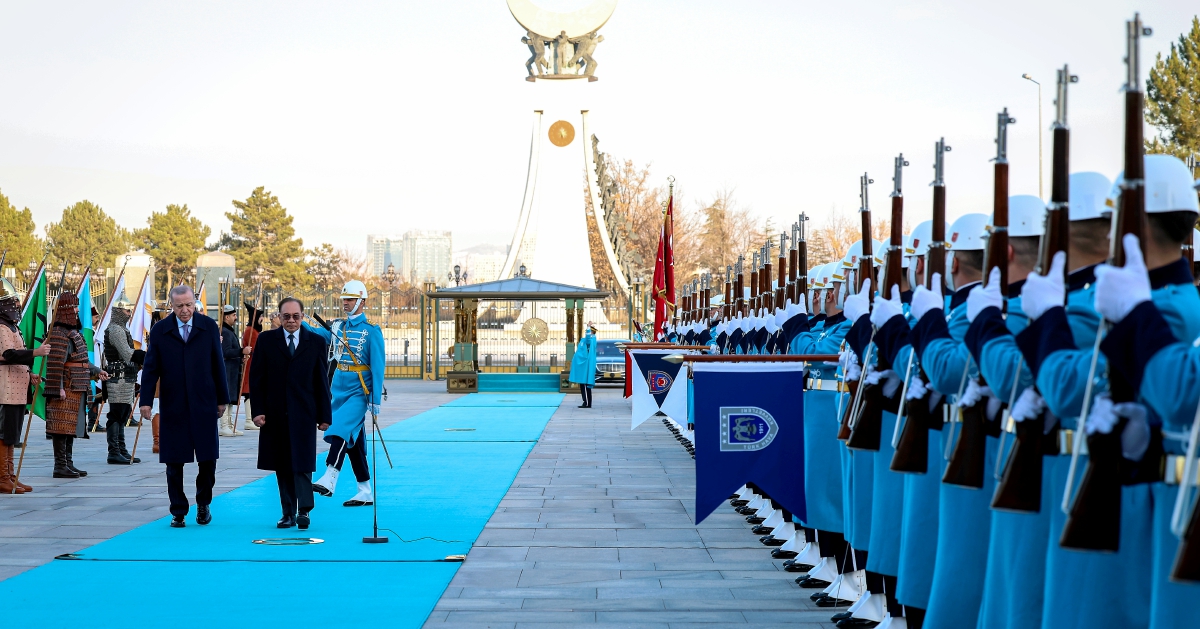
In an interview with TRT World, Anwar spoke of his trials and tribulations, and expressed gratitude for how President Recep Tayyip Erdogan had stood by him “in true friendship”.
The three-day official visit to Turkiye could not have been timelier or more strategic, and underscores a paradigm shift.
Crucial as the ties between Anwar and Erdogan are, personal relationships are not the be-all and end-all in international diplomacy. At play is a clear-eyed recalibration of national interest.
As Anwar put it, Malaysia-Turkiye engagements manifest “a strategic judgment about the kind of world we now inhabit, and about the choices that countries like ours must make to preserve autonomy, stability and growth”.
It is a paradigm shift — one that not only elevates diplomatic ties to a more strategic level, which would entail enhanced cooperation across the board, but also underscores a more definitive geopolitical positioning in the global arena.
To be sure, it is not a shift away from Malaysia’s foreign policy of non-alignment, as was made clear by Anwar’s articulation of balanced relations with the United States and China while deepening ties with Turkiye.
Nevertheless, what could be discerned is a palpable reordering of strategic priorities alongside governance guardrails.
This is exemplified in the inaugural Malaysia-Turkiye High-Level Strategic Cooperation Council (HLSCC), underlining the key word “strategic” and signifying the transition from mere cooperation — seen as being contingent on the vagaries of leadership status — to one that is more secure and predictable.
In light of this, it would not be frivolous to ask what Malaysia could offer Turkiye, and what Turkiye could offer Malaysia.
Without attempting to cover the entire terrain, in terms of trade and investment, Malaysia offers strategic access to Turkiye not just to its domestic market but also as a gateway to other Asean economies. While that could be a cliched motif, suffice it to say that Turkiye could export more goods and services while its economy could benefit from investment opportunities, particularly in infrastructure, energy and technology sectors.
Although not spoken of, even as Turkiye remains a North Atlantic Treaty Organisation member, by enhancing ties with Malaysia it could garner brownie points in Southeast Asia, thereby fortifying its geopolitical position in the region.
The kicker here would be a boost for Turkiye’s already burgeoning defence exports to Malaysia.
Turkiye could also work hand in hand with Malaysia on a vast array of cross-cutting issues of global import, not the least being the Sustainable Development Goals and climate change initiatives.
What then could Turkiye offer to Malaysia that would count as geopolitically impactful? It might well be a voice in the wilderness that posits a strategic middle-power convergence of the two countries, separated by more than 8,000km. But on deeper reflection, as the global order becomes increasingly fragmented, there is no distance that cannot be bridged.
Both, being emerging economies, share more commonalities than differences, with diversified industrial bases, including vibrant manufacturing and service sectors. Both are also Muslim-majority nations and vociferous — in a good way — members of the Organisation of Islamic Cooperation. It stands to reason to explore the possibility of Malaysia looking to Turkiye not as some patronising big brother, but as a strategic safeguard on the European side of the Bosphorus.
On trade and investment, Malaysia could leverage Turkiye and avail itself of multiplier effects in engaging emerging markets and Muslim-majority states for its myriad of products in the halal sector as well as the Islamic capital market, effectively serving as a gateway beyond Asean and East Asia.
From the prism of bilateral trade, there is an ambitious target of US$10 billion by 2026, a major surge from the US$4.92 billion recorded from January to November 2025.
This would leverage high-value sectors such as semiconductors, artificial intelligence, data centres, energy, advanced electrical and electronics, agri-commodities, halal foods and rare earths from Malaysia.
On Turkiye’s side, strengths include advanced defence manufacturing, automotive and construction, research and development, higher education and industrial design.
The HLSCC, defence procurements and other agreements mean that mechanisms are in place to explore further avenues towards doubling the trade volume goal. Hence, although a formidable challenge, the US$10 billion target is not a pipe dream.
As a testament to the expanding role of track two diplomacy and its impact on strategic policy narratives and public discourse, a memorandum of understanding was inked between the Institute of Strategic and International Studies of Malaysia and Turkiye’s premier think tank, Seta (Foundation for Political, Economic and Social Research).
This partnership will advance strategic research collaboration on international, economic and social policy, foster the exchange of researchers and experts, and strengthen policy research networking.
Going forward, Isis Malaysia will organise the first major Isis-Seta collaborative event in Kuala Lumpur this year.
Anwar’s public lecture, titled “Power Shift: Strategic Choices for Malaysia and Turkiye”, drew a packed audience where he posited that both countries are aligned on many issues of consequence. In addition to the commonalities enumerated earlier, both have insisted that “human rights lose meaning when applied selectively, and that justice must rest on law rather than the convenience of the strong”.
Lamenting the slow death of the “voice of conscience” in international relations and the increasing hypocrisy of the global discourse on justice, Anwar stressed that no nation “has the right to trample on the sovereignty of another”, nor has it the licence to act with impunity beyond its borders.
By all accounts, Anwar’s visit was a success, chalking up substantive geopolitical and geo-economic takeaways, capped with a strategic recalibration of Malaysia-Turkiye relations.
This reset encapsulates both nations’ commitment to long-term exploration of mutual cooperation aimed at benefiting both economies, while further strengthening the bonds of kinship well into the future.
The writer is chairman of the Institute of Strategic and International Studies Malaysia
The views expressed in this article are the author’s own and do not necessarily reflect those of the New Straits Times
© New Straits Times Press (M) Bhd