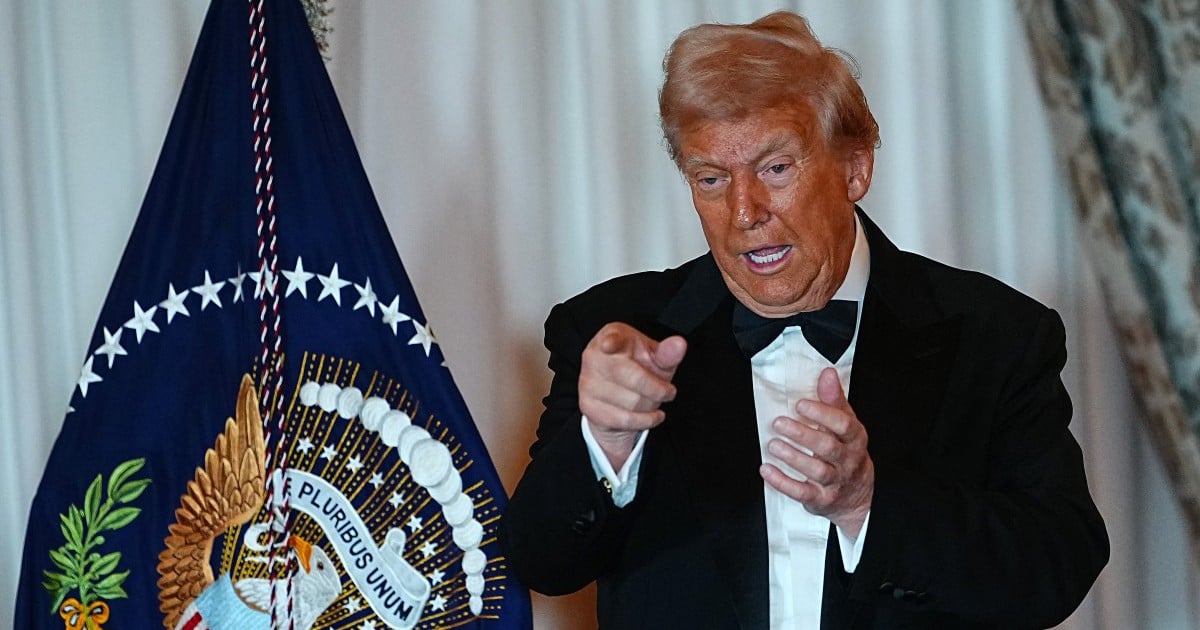
UNITED States President Donald Trump laid out a radical realignment of foreign policy on Friday, shifting the superpower’s focus from global to regional, criticising Europe as facing “civilisational erasure” and putting a priority on eliminating mass migration.
The national security strategy, meant to flesh out Trump‘s norms-shattering worldview, elevates Latin America to the top of the US agenda in a sharp reorientation from longstanding US calls to focus on Asia to face a rising China.
“In everything we do, we are putting America First,” Trump said in a preamble to the long-awaited paper.
Breaking with decades of attempts to be the sole superpower, the strategy said that the “United States rejects the ill-fated concept of global domination for itself”.
It said the US would also prevent other powers, namely China, from dominating, but added: “This does not mean wasting blood and treasure to curtail the influence of all the world’s great and middle powers.”
The strategy called for a “readjustment of our global military presence to address urgent threats in our Hemisphere”, starting with migration.
“The era of mass migration must end,” the strategy paper said.
The strategy made clear that the US under Trump would aggressively pursue similar objectives in Europe, in line with far-right parties’ agendas.
In extraordinary language for addressing close allies, the strategy said the administration would be “cultivating resistance to Europe’s current trajectory within European nations”.
Germany quickly hit back, saying that it does not need “outside advice”.
Democratic Congressman Gregory Meeks said the document “discards decades of values-based US leadership in favour of a craven, unprincipled worldview”.
The strategy pointed to Europe’s slide in share of the global economy — which is the result largely of the rise of China and other emerging powers — and said the “decline is eclipsed by the real and more stark prospect of civilisational erasure”.
“Should present trends continue, the continent will be unrecognisable in 20 years or less.”
As Trump seeks an end to the Ukraine war that would likely favour Russia gaining territory, the strategy accused Europeans of weakness and said the US should focus on “ending the perception, and preventing the reality, of Nato as a perpetually expanding alliance”.
Since returning to office in January, Trump has ordered sweeping curbs on migration, after a political career built on fanning fears that America’s white majority is losing its status.
The strategy speaks in bold terms of pressing US dominance in Latin America, where the Trump administration has been striking alleged drug traffickers at sea, intervening to bring down leftist leaders and seeking to take charge of key resources such as the Panama Canal.
The strategy casts Trump as modernising the two-century-old Monroe Doctrine, in which the then young United States declared Latin America off-limits to rival powers.
The strategy paid comparatively little attention to the Middle East, which has long consumed Washington.
Pointing to US efforts to increase energy supply at home and not in the oil-rich Gulf, the strategy said: “America’s historic reason for focusing on the Middle East will recede.”
The paper said it is a US priority for Israel to be secure, but stopped short of the fulsome language on Israel used even in the first Trump administration.
On China, the strategy repeated calls for a “free and open” Asia-Pacific region, but focused more on the nation as an economic competitor.
After speculation on whether Trump would budge on Taiwan, the self-ruling democracy claimed by Beijing, the strategy made clear that the US supports the decades-old status quo.
But it called on allies Japan and South Korea to contribute more to ensure Taiwan’s defence.
The strategy puts little focus on Africa, saying the US should transition away from “liberal ideology” and aid, and instead secure critical minerals.
US presidents usually release a National Security Strategy in each White House term. The last, released by Joe Biden in 2022, prioritised winning a competitive edge over China while constraining Russia.
The writer is from AFP
© New Straits Times Press (M) Bhd