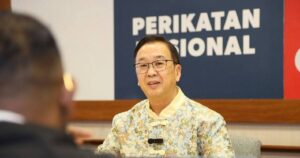

KUALA LUMPUR: Lim Ah Yin was only 11 when British troops gunned down her father in the Batang Kali massacre of 1948 — a crime unacknowledged for more than half a century. “She had a strong reaction. She suffered from nightmares and felt as if she couldn’t escape this life,” said Datuk Quek Ngee Meng, a lawyer who led the legal effort to bring the case to British and European courts.
It took the United Kingdom 77 years to formally acknowledge the Batang Kali massacre as a tragedy — having expressed its “deep regret” in April this year. The decades-long quest for justice began with Ngee Meng’s father, Quek Jin Teck, who founded the Action Committee Condemning the Batang Kali Massacre in 2008.
Ngee Meng continued the fight after his father’s death in 2010. His legal team, including Datuk Firoz Hussein Ahmad Jamaluddin and Datuk Dominic Puthucheary, worked with British lawyer John Halford and three King’s Counsellors: Michael Fordham, Danny Friedman and Professor Zachary Douglas. Unfortunately, they lost the case in the UK Supreme Court in 2015 and the European Court of Human Rights in 2018.
However, the UK Supreme Court’s judgment contained a crucial acknowledgment, with the judges stating that there was “overwhelming evidence that the 24 men were murdered” and that the official account of them being shot while trying to escape was “a lie”. The ensuing years saw a determined effort to keep the memory of the massacre alive via public awareness campaigns, lobbying of members of parliament and direct appeals to the government. The letter of apology from the UK government, while not conceding to a public inquiry, formally expresses regret for the killings and the suffering caused to the families.
Ngee Meng said another survivor, Tham Yong, also carried a heavy psychological burden. “Every time she recollected the memories, she was reminded of ‘this innocent person who was killed’. In her heart, she felt injustice.” The survivors had long hoped that someone would take the issue forward, he added, and remained steadfast for decades. “Even though they are now in their 70s and 80s, they sat in courts whose the language was foreign to them. They wanted to be told that someone would be held accountable,” he added.
On Dec 11, 1948, during the Malayan Emergency, a 14-man patrol led by Lance Sergeants Charles Douglas and Thomas Hughes of the Scots Guards entered a rubber plantation in Batang Kali, south of Kuala Kubu Bharu, Selangor. They detained about 50 unarmed adults and children on suspicion of communist links, with the men and women held separately. That evening, one of the villagers, Loh Kit Lin, was shot and killed after an interrogation.
[[nid:1335165]]
The next morning, the women and children were sent to Ulu Yam Bharu while another 23 men were executed and the village burnt down, according to papers submitted to the UK and European courts. Official reports by the colonial government initially described the men as “bandits” gunned down during an escape attempt. Survivors and relatives, however, gave a different account and called for a probe. However, no investigation was carried out as the Emergency Regulations at the time removed the obligation to hold an inquest into military killings.
Despite the latest developments, the massacre in Batang Kali still casts a long shadow over those whose family members were killed. “When I was young, my grandfather would always tell us, ‘Don’t be naughty or we will throw you to that place’ — that place meaning Ulu Yam,” said Professor Ng Yean Leng, who teaches Chinese Studies at New Era University.
“My father didn’t tell me about the massacre,” she said, adding that memories of the tragedy still haunted her family. Ng said her older relatives followed the legal proceedings closely and believed that the next generation had a responsibility to do the same. “Those killed were just farmers. They probably didn’t even know the reason they were killed.”
© New Straits Times Press (M) Bhd