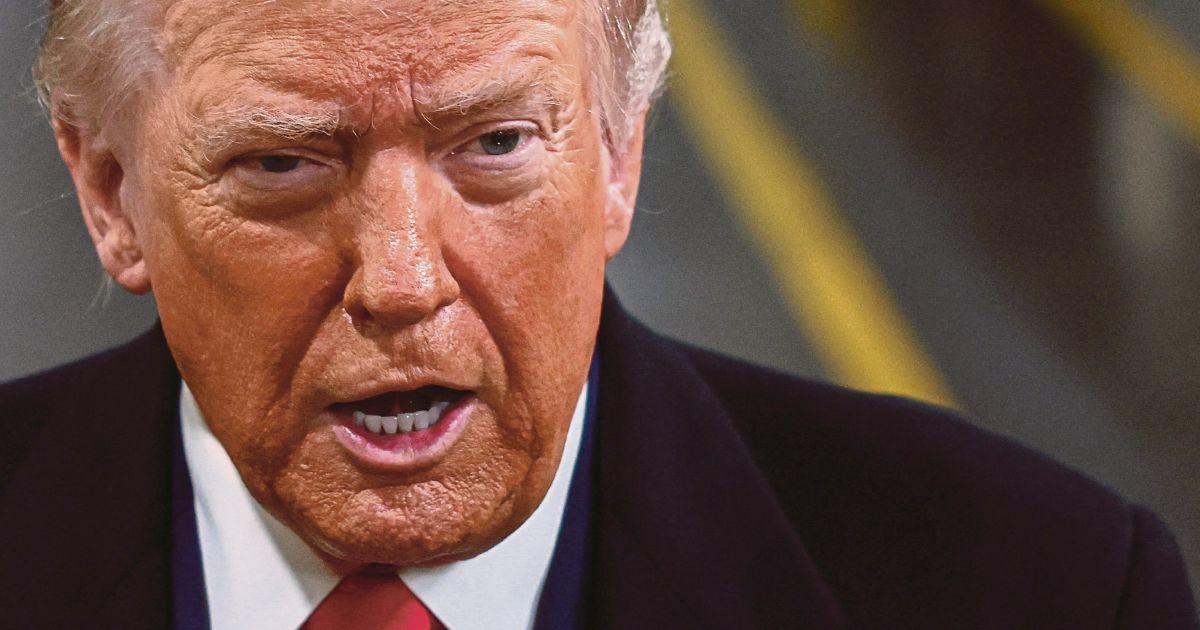
FROM playing football in the Oval Office to sipping cocktails on a sun lounger in Gaza and attacking critics from a jet-fighter, Donald Trump has become the first United States president to deploy artificial intelligence (AI)-generated imagery as a key tool of political communications.
In the first year of his second term in the White House, Trump ramped up his use of hyperrealistic but fabricated visuals on Truth Social and other platforms, often glorifying himself while lampooning his critics.
Underscoring the strategy’s potential appeal to younger voters, similar AI-driven messaging has also been adopted by other arms of the Trump administration as well as by some of the president’s rivals.
One of Trump’s posts depicts him playing football on the Oval Office’s carpeted floor with Cristiano Ronaldo, whom he describes as a “GREAT GUY” who is “really smart and cool”.
Another AI post features Trump and Israeli Prime Minister Benjamin Netanyahu sunbathing at a lavish resort, with “Trump Gaza” emblazoned on a sign in the background.
The clip followed Trump’s proposal last year to turn Gaza into the “Riviera of the Middle East”, a suggestion that sparked widespread outrage.
Trump or the White House have similarly shared AI-made images showing the president dressed as the pope, roaring alongside a lion, and conducting an orchestra at the Kennedy Centre, a prestigious arts complex.
“Welcome to the United States’ first White House administration to embrace and use imagery generated by artificial intelligence in everyday communication,” said a report by the non-profit media institute Poynter.
“With AI, Trump quickly deploys stereotypes and false narratives in entertaining posts that memorably distill complicated issues into their basest political talking points, regardless of factual basis.”
Trump has reserved the most provocative AI posts for his rivals and critics. Last year, he posted an AI video of former president Barack Obama being arrested in the Oval Office and appearing behind bars in an orange jumpsuit.
Later, he posted an AI clip of House minority leader Hakeem Jeffries — who is Black — we aring a fake mustache and a sombrero. Jeffries slammed the image as racist.
“For someone like Trump, unregulated generative AI is the perfect tool to capture attention and distort reality,” said Nora Benavidez, senior counsel at the advocacy group Free Press.
Analysts say the AI messaging amounts to a strategy of campaigning through trolling, a tactic that could resonate with voters ahead of this year’s midterm elec tions.
“While it would in many ways be desirable for the president to stay above the fray and away from sharing AI-generated images, Trump has repeatedly demonstrated that he sees his time in office as a non-stop political campaign,” said Joshua Tucker, codirector of the New York University Centre for Social Media and Politic s.
In a study published last month by the scientific journal Nature , academics, including Cornell University ‘s David Rand, reported that human-AI dialogues may have a substantive effect on voter s’ electoral decisions.
Back-and-forth exchanges with AI tools advocating for political candidates had shifted opposition voters’ preferences substantially in the US, Canada and Poland, said the study.
In a sign of its potency, Trump’s AI strategy has been mimicked by other departments of his administration and his critics.
Trump’s health chief Robert F. Kennedy Jr — under fire over medical misinformation — r ecently promoted a “Make Santa Healthy Again” Christmas campaign using an AI video, while the US Immigration and Customs Enforcement deployed AI imagery in its immigration crackdown.
Last month, California Governor Gavin Newsom, a Democrat, trolled the president by posting an AI video on X depicting Trump and two senior administration officials in handcuffs.
“It’s cuffing season,” the video declared.
The writer is from AFP
© New Straits Times Press (M) Bhd