
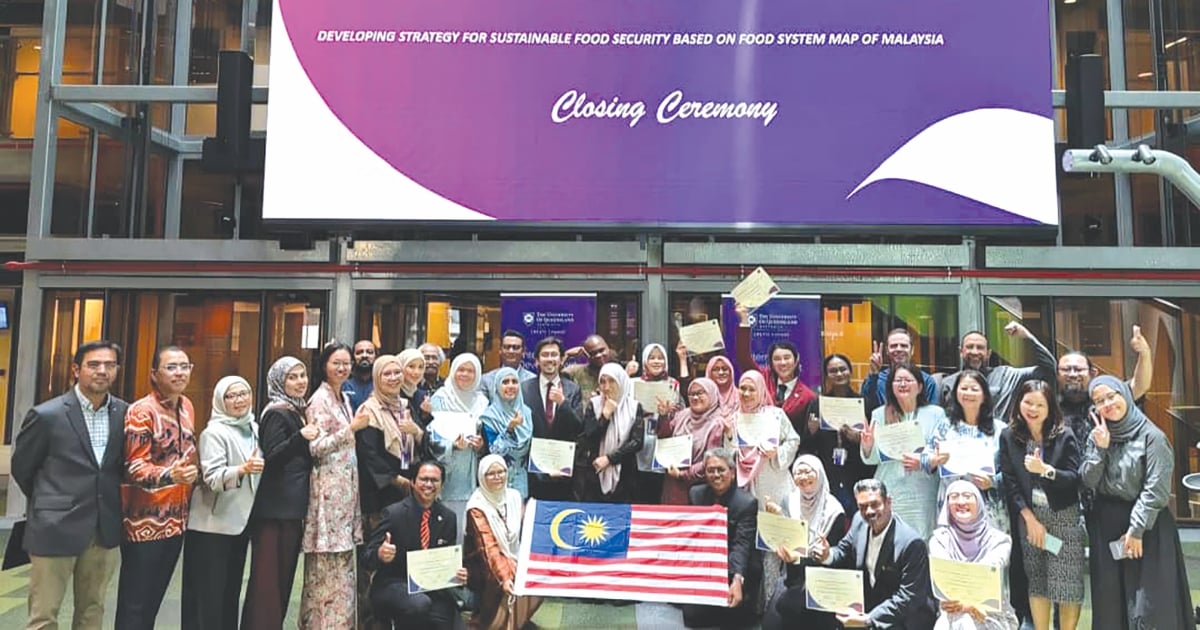
MALAYSIA is building a cadre of experts in food systems and food security, with 22 senior government officers recently completing the Program Pembangunan Kepakaran dan Perunding Kerajaan (Prestij).
The six-month programme, funded by the Public Service Department (PSD), included one month of training in Malaysia and five months at the University of Queensland, Australia.
Binaskil Academy chief executive officer Dr Affaro Affandy said the completion of the second batch brings the total alumni to 35, making Malaysia one of the first countries to develop government leaders in these specific fields.
“Prestij aims to develop consultants within the government who can advise, design, and implement policies on food security and systems transformation, aligned with global and United Nations trends,” he said.
Binaskil Academy, a consulting firm that specialises in food systems and national-level capacity building, was appointed by PSD as the programme’s training provider.
Affaro said the programme was introduced in 2024 under the Accelerated Course for Competency Excellence (ACE) to produce experts in food systems transformation.
It was rebranded as Prestij this year, with a stronger mandate to develop officers as subject-matter experts and government consultants.
Participants in the second cohort, selected from various agencies, gained first-hand exposure to Australia’s best practices through site visits, policy dialogues and strategy-focused workshops with local institutions and industry players.
[[nid:1342571]]
Affaro said the programme has produced leaders with a comprehensive understanding of the food system — from production, imports, trade, logistics and regulation to consumption, waste and sustainability.
“These officers can act as internal consultants, analyse complex food security challenges, provide evidence-based policy advice, and support strategy development and implementation,” he added.
Over the six-month programme, participants gained comprehensive training in food systems and food security, agricultural and fisheries value chains, climate-smart and sustainable agriculture, food safety, and quality management, trade, logistics and regulatory issues affecting food supply.
They were also trained in systems thinking, including problem analysis, systems mapping, identifying leverage points and group model building to engage stakeholders and solve complex challenges collaboratively.
[[nid:1342570]]
In addition, the programme equipped participants with policy and strategic skills, such as policy analysis, stakeholder engagement, coalition-building, strategy development and practical techniques for communicating evidence and influencing policy decisions.
“In the final week of the programme in Australia, participants delivered their presentations, focusing on the food systems and food security priorities of their respective ministries and agencies.
“The current Prestij cohort has also developed intervention strategies that identify key leverage points in the Malaysian food system and proposed strategic actions aligned with national policies and ministry mandates,” he said.
“The strategic actions were developed based on the food systems map, which was created by the previous 2024 cohort and refined by the current cohort. Strategies were formulated and leverage points were identified through this food systems map.”
He also proposed the establishment of the Malaysian Institute for Food Systems Transformation, a specialised think tank where Prestij alumni could serve as fellows, contributing their expertise.
[[nid:1342569]]
Binaskil also aims to continue working with the Agriculture and Food Security Ministry to make full use of the Prestij alumni’s expertise.
“As the coordinating ministry for food security, the ministry provides overall policy direction and ensures that efforts are strategically aligned.
“The ministry secretary-general’s (Datuk Seri Isham Ishak) keynote during the programme highlighted how Prestij supports the national food security agenda and contributes to broader food systems transformation at both national and global levels,” Affaro said.
Affaro hopes to continue the programme and plans to expand its reach and impact, with support from PSD.
“So far, the ACE and Prestij cohorts have focused on the upstream side of the food system, which involves the early stages of food production, including ministries and agencies responsible for agriculture, research and regulation.
“The next step is for Malaysia to invest in developing expertise along the downstream value chain to complement this work.
“By connecting the current upstream expertise with a new layer of downstream specialists, Malaysia can significantly strengthen its capacity to transform the entire food system from production to consumption,” he said.
Participant Norhani Hashim said the programme enables participants to gain a comprehensive understanding of the entire food chain system — from supply chain management and import-export processes to monitoring and controlling entry points at the national borders.
The programme also exposed participants to updated tools and systems thinking, preparing them to identify problems right down to their root causes.
“This is a useful programme, and I hope PSD will consider sending more participants in the next batch.
“This will help Malaysia ensure that our food security and food supply chains remain at an optimum level,” said the senior customs officer.
Another participant, Noor Syahira Nasarudin, described her six-month journey as both amazing and fruitful.
“When I came here as a plant breeder, I had zero knowledge of systems thinking. Now, I am a systems thinker.
“It’s all about seeing the bigger picture — understanding how things are interconnected and recognising the feedback loops,” said the officer from the Malaysian Agricultural Research and Development Institute (Mardi).
Noor Syahira said the networking opportunities built through the programme would also be highly beneficial in fostering professional connections and collaborations for future projects.
“I will return to Malaysia with a fresh mindset and a new set of skills. I can’t wait to share and apply everything I have learned here at the University of Queensland,” she said.
Meanwhile, Sharifah Hafiza Mohd Ramli said she gained valuable insights, particularly from the industrial visits.
“No other courses allow you to visit factories and farms in Australia — only this programme provides such opportunities.
“If you are selected to participate, make sure you take full advantage of it,” said Sharifah Hafiza, also from Mardi.
All 22 officers were honoured in a ceremony held on Dec 5 at the University of Queensland, where they received their certificates of completion from the university and Binaskil Academy.
The event was officiated by the Deputy High Commissioner of Malaysia in Australia Khairul Gadafi Kamaludin. Also in attendance was a representative from PSD, Sharifah Khadijah Tuan Hadi.
[[nid:1342568]]
© New Straits Times Press (M) Bhd