THE rampant smuggling and production of drugs in Malaysia can be explained in simple economic terms — where there is demand, enterprising cartels, farmers, gangs and street peddlers will ensure supply, death penalties be damned.
It has been a highly lucrative trade globally. According to last year’s World Drug Report by the United Nations, 316 million people worldwide are using drugs. It also found a sharp spike in the production and seizure of narcotics globally from 2010 to 2020s.
Though the report does not give a value for total global drug trafficking, we can only imagine that is has reached trillions considering a 2017 report by Washington-based think tank Global Financial Integrity that valued the trade at US$650 billion.
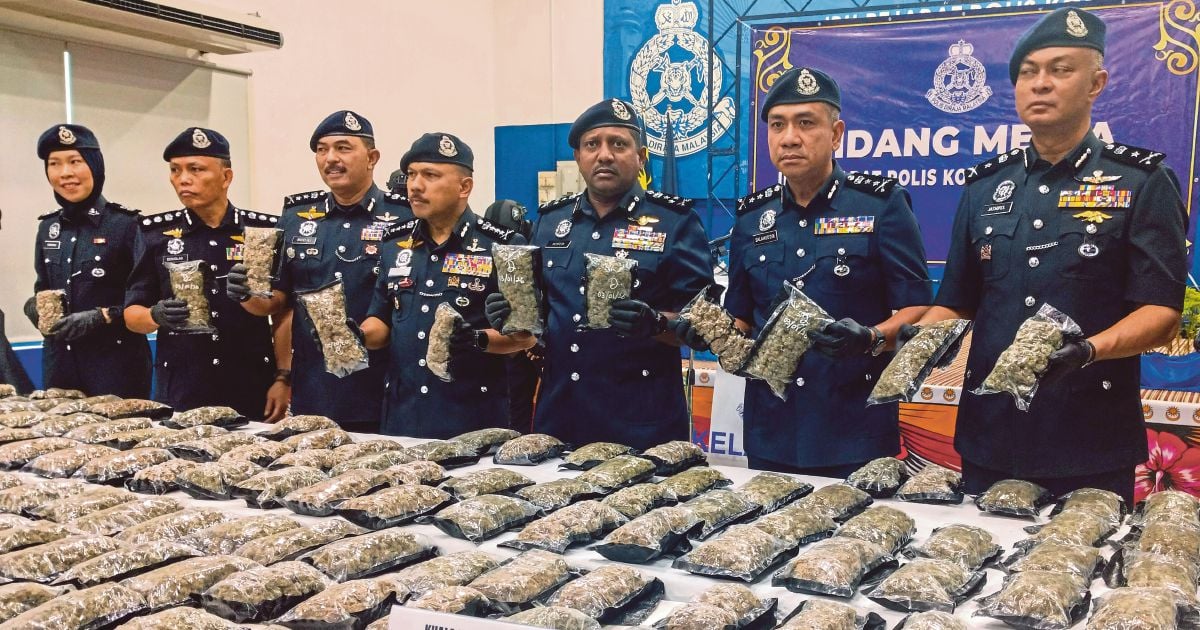
In Malaysia, the value of seized drugs is a head-spinning RM3.1 billion, based on the 215 tonnes found in raids on 270 syndicates. Kuala Lumpur tops the seizures table at RM1.1 billion.
The Customs Department, too, has found drugs to be its highest category of seizure — RM478.5 million. This is sobering: for all drugs seized and intercepted, much, much more enter and leave the country undetected, making profit margins vary wildly.
Malaysia is but a tiny entry point for the world’s illicit drug trade. The major ones are in Mexico and Colombia, where gangs control cocaine, heroin and methamphetamine trafficking, particularly for the American market.
In Southeast Asia, the Golden Triangle countries of Myanmar, Laos and Thailand are primary sources for heroin and methamphetamine, with China being the major synthetic drug producer.
Here’s an idea of drugs’ street value: local traffickers import or produce a kilogramme of meth at about RM50,000 and resell it at RM200,000 to RM400,000 per kg, taking into account enforcement losses and distribution costs.
Malaysia’s long coastlines and porous jungle borders offer smugglers many avenues.
A favoured tactic is smuggling drugs in large containers through ports, as shown in the recent seizure of 33.2 tonnes of Iranian meth meant for Australia worth RM1.06 billion at Port Klang. The two big containers used for the deed were labelled as containing paraffin wax.
It cuts both ways: as a major hub for huge container traffic, Port Klang’s world-class logistics is also an inadvertent boon as a transit point for major drug trafficking.
In any case, the police’s success reflects Malaysia as a hub where shipments fail, not succeed — a compliment to active enforcement, aided by intelligence gathering from relevant agencies.
At a lower level, smuggling relies on the coercion of vulnerable individuals (huge debts), deception (fake jobs, scholarships and relationships) and exploitation of unwitting carriers, otherwise known as mules.
© New Straits Times Press (M) Bhd