
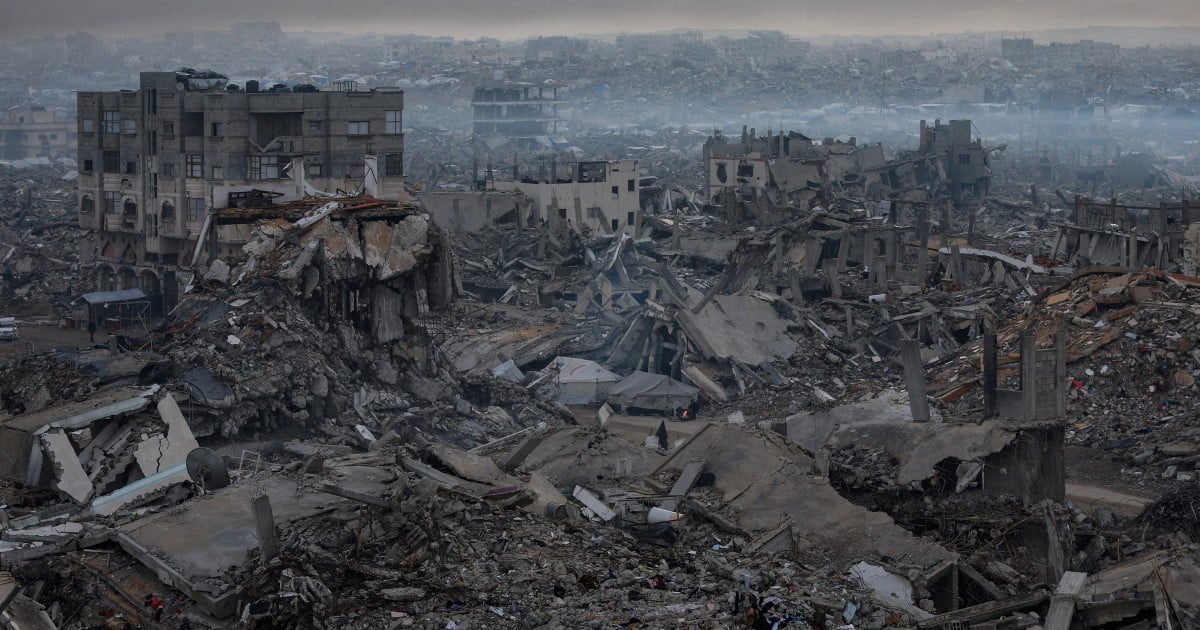
WHEN United States President Donald Trump announced the 20-point Gaza peace plan in October, Palestinians saw more fragility than hope.
The past two months since then have proven them right, with the genocidal Israelis using every little excuse to break the agreement. Now that the Gaza peace plan is entering the second phase, it is facing a more fragile moment. There are several reasons for this.
Let’s go to the beginning. History tells us that any peace plan for Palestine will fail because of the involvement of Israel, an illegal occupier of Palestinian land. If not for the support of Britain, Europe and the US — the impunity boosters of the Jews-only state — Israel would not exist today.
The same deceitful support continues today so much so that alleged war criminal Prime Minister Benjamin Netanyahu had the audacity to reject the Trump-initiated United Nations Security Council draft resolution because of a reference to a Palestinian state, albeit in the vaguest of language.
“Our opposition to a Palestinian state on any territory has not changed,” news agency AFP quoted Netanyahu telling a cabinet meeting on Sunday. Audacious to say the least given that Israel is an illegal occupier under international law. No less than the International Court of Justice has ruled on this matter several times in the recent past. It shouldn’t have a seat at the negotiating table.
The second reason for the fragility of the Gaza peace plan is the studied reluctance of the UNSC text to clearly mention the endpoint being a Palestinian state as determined by the Palestinians.
The text sighted by AFP appears to place such a Palestinian state as far away into the future as possible. The draft resolution goes on to say that once the Palestinian Authority has carried out requested reforms and the rebuilding of Gaza is underway, “the conditions may finally be in place for a credible pathway to Palestinian self-determination and statehood”.
A clear intent to postpone a Palestinian state forever?
Little wonder, veto-wielding Russia has circulated a competing draft, saying the US text doesn’t go far enough towards backing the creation of a Palestinian state, our third reason for the fragility of the Gaza deal.
AFP quotes Russia as asking the UNSC to express “its unwavering commitment to the vision of the two-state solution”. The Moscow text also refuses to authorise a Board of Peace or the deployment of an international peacekeeping force, instead asking the UN secretary general to offer options on the issues.
Palestinian factions, too, are unhappy with the US text, especially the Board of Peace and the deployment of an international peacekeeping force, saying that they are an attempt to impose foreign guardianship over the territory and sideline Palestinian decision-making.
In a joint statement published in Turkish media, the Palestinian factions said the move is to strip the Palestinians of their rights to govern their own affairs.
© New Straits Times Press (M) Bhd