
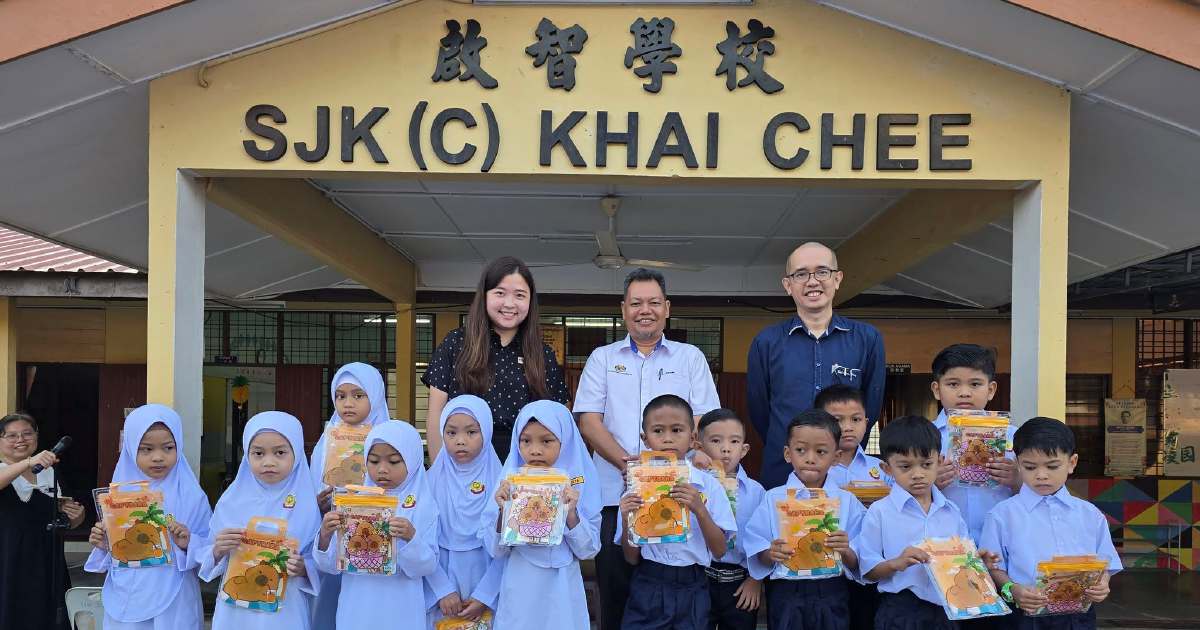
KUALA LUMPUR: A Chinese primary school in Kuala Kangsar has seen a surge in non-Chinese enrolment, with Malay pupils now making up over 90 per cent of its student body.
A photo circulating on social media showing the start of the school year at SJK (C) Khai Chee in Kati went viral, as Malay pupils outnumbered Chinese pupils during an assembly.
The school’s board chairman, Leong Yoke Kong, said the school now has a total of 57 pupils for the new academic year, of which more than 53 are Malay, China Press reported.
He added that the school has opened classes for all year levels, from Year One to Year Six.
The ethnic composition of the student body is similar to recent years, with a consistently high proportion of non-Chinese pupils — a trend that is no longer new within the Chinese primary school system.
“Most non-Chinese pupils come from nearby areas, while some are referred by parents from outside the district, particularly those working in education,” he said.
According to Leong, many parents choose Chinese primary schools to give their children the advantage of learning an additional language, as well as because Chinese schools are perceived to perform well in mathematics and science and are known for good discipline.
“Some parents have also openly said that their children faced bullying or difficulties adapting in national schools, which is why they transferred them to a Chinese primary school,” he said.
He added that parents with higher educational backgrounds often hope their children can develop bilingual or even multilingual abilities from a young age, thereby enhancing their prospects for further education and employment.
However, Leong acknowledged that a high proportion of non-Chinese pupils presents challenges for teachers as many pupils have little or no foundation in Mandarin before enrolment, requiring teachers to start from the basics.
For subjects such as mathematics and science, lessons often have to be conducted bilingually in Mandarin and Malay to ensure pupils understand the content.
“Year One pupils tend to adapt more quickly. It is those who transfer midway who usually face greater learning pressure,” he said.
“As a result, teachers need to invest more patience and time, and the overall teaching workload is heavier.”
[[nid:1357463]]
Liang believes that the continued rise in the proportion of non-Chinese pupils in Chinese primary schools will not only persist in Kuala Kangsar district but is likely to become increasingly common elsewhere as well.
He noted that when he became chairman of the school board about 10 years ago, the number of Malay pupils had already surpassed that of Chinese pupils.
Leong further revealed that although Malay pupils now make up about 90 per cent of the school’s enrolment, Khai Chee, as a government-aided (partially funded) school, has not received any preferential treatment.
Funding allocations and teacher postings remain the same as for other Chinese primary schools.
“Khai Chee has not received more funding or teachers than other Chinese schools, nor has it been given any special attention. Everything operates as usual,” he said.
He added that, besides Khai Chee, there are also other Chinese primary schools in the Kuala Kangsar district where Orang Asli pupils outnumber Chinese pupils.
© New Straits Times Press (M) Bhd