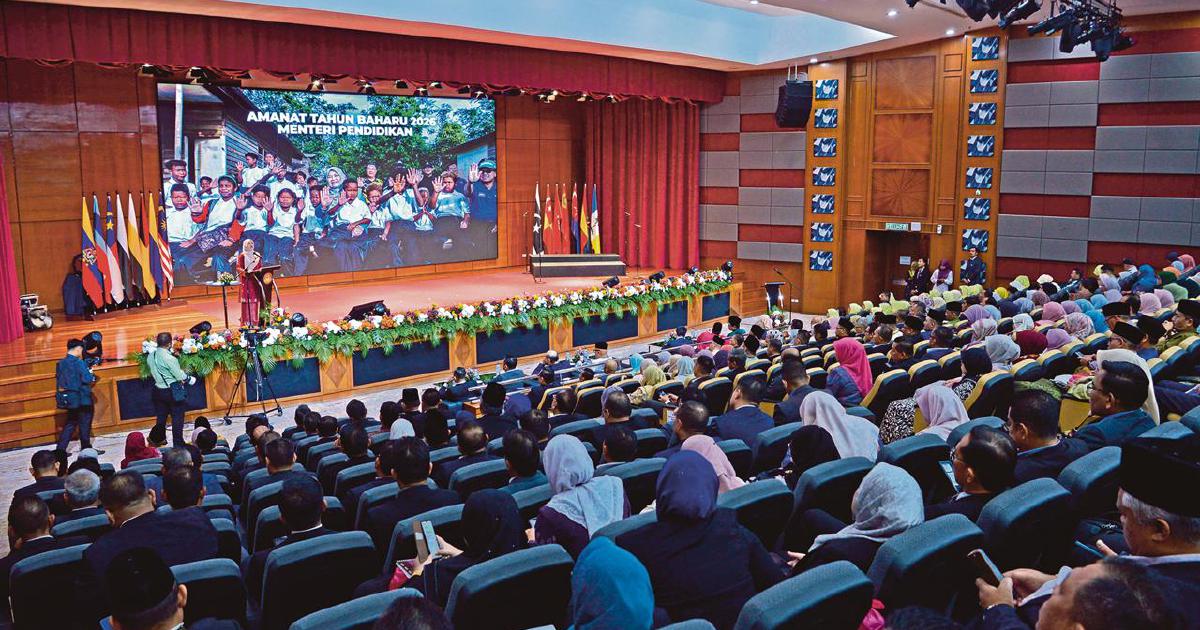
PUTRAJAYA: Education Minister Fadhlina Sidek has laid out an ambitious, reform-driven roadmap for Malaysia’s education system in her 2026 New Year Address, describing the coming year as a critical turning point for translating long-planned reforms into tangible outcomes in classrooms nationwide.
She called on educators and administrators to face 2026 with a fresher spirit, a clearer direction, and a trust that is truly understood, not merely spoken of.
She said the country stood at a critical crossroads in its education journey, with the Education Development Plan 2026–2035 set to guide policy and decision-making for the next decade.
At the same time, the ministry will begin implementing a new school curriculum, starting with the 2026 Preschool Curriculum, which she described as the first concrete step towards the broader School Curriculum 2027.
2025 ACHIEVEMENTS
Reflecting on the past year, the minister said 2025 closed with many historic successes, achieved through difficult decisions and sustained effort, driven by the belief that “education can no longer be postponed.”
She said the passage of the Education (Amendment) Act was a defining moment, binding a promise that every child’s right to learn from primary to secondary school is a right that cannot be compromised.
Malaysia’s education achievements also gained international recognition, with SK Putrajaya Presint 11(1) winning the World’s Best School Prizes in the Supporting Healthy Lives category.
“A local school, standing tall on the international stage,” Fadhlina said, describing the accolade as evidence that the quality of Malaysia’s education was being recognised globally.
She also highlighted individual excellence among teachers, highlighting that educator Muhammad Nazmi was named among the Global Teacher Prize 2025 finalists, while Dr Velerie Wheeler von Primus of SK Bingkor, Keningau, Sabah, became a Top 50 finalist for the Global Teacher Prize 2026.
“Let us pray together that Velerie succeeds in being crowned the champion of the Global Teacher Prize 2026 and becomes an inspiration to the entire community of educators in our country,” she said.
However, Fadhlina acknowledged that teacher numbers alone were not enough if educators remained overburdened with non-teaching duties.
To address this, she said the ministry had taken phased steps to reduce workload, including deploying 562 teacher assistants and 600 hostel warden assistants under MySTEP, operational support in 281 secondary schools, and improvements to lesson planning processes.
“These were implemented so that teachers can return to focusing on their core duty, which is teaching,” she said.
She said 2025 also marked the end of a long-standing issue with the abolition of the Education Ministry Training Management System, a move driven by the conviction that the voice of teachers must be heard.
On infrastructure, the minister said a record 44 new schools were completed last year, while another 44 dilapidated schools were restored, allowing pupils to learn in safer classrooms with clean facilities and functioning laboratories.
Curriculum interventions also yielded measurable gains, with 398,496 pupils successfully mastering basic literacy and numeracy skills under the 3M framework.
Support for students with special educational needs was strengthened through an allowance of RM150, expansion of specialised centres and classes, new Permata centres, and early detection initiatives such as ProsPIM and Prosper.
“These efforts alleviate the burden on families from as early as the age of 4,” she said.
On student safety, she cited findings from a nationwide Student and Hostel Safety Audit covering 850 schools, which informed the ministry’s Immediate Reform agenda.
Based on the audit, the ministry established a Student Protection Policy emphasising prevention, early intervention and shared accountability, supported by comprehensive Safe School Management Guidelines.
These guidelines, she said, bring together agencies including the police, National Institute of Occupational Safety and Health, the Health Ministry, academics, non-governmental organisations and local communities.
A VISION FOR 2026
Fadhlina said the return of the school calendar to a January start, after four years, was a major operational decision long-awaited by parents.
Malaysia’s education reforms have also drawn international confidence, with the country elected to Unesco’s Executive Board for the 2025–2029 term.
The appointment, Fadhlina said, reflected global trust in Malaysia’s ability to represent developing nations, particularly in Southeast Asia and the Asia-Pacific region.
School reform efforts will be intensified this year, with programmes such as Sekolah Inspirasi, Sekolah Aspirasi and Sekolah Fokus used as mechanisms to improve school management.
“The numbers speak for themselves,” she said, highlighting that Sekolah Inspirasi increased to 4,400 schools from just six in 2023, while Sekolah Fokus fell sharply to 246 schools from 3,822.
“This proves that targeted interventions, guided by data and the actual needs of schools, are capable of producing real results,” she added.
Looking ahead, reform will begin at the earliest stage with the 2026 Preschool Curriculum, which emphasises self-management, reading interest, digital literacy, integrated learning and character building in an inclusive environment.
The government has allocated RM125 million for repairs and maintenance, supporting more than 10,000 preschools nationwide across multiple institutions.
Fadhlina also outlined a series of “Quick Wins” under the Education Development Plan 2026–2035, including new schools, upgrades to dilapidated facilities, expanded computer labs and installation of closed-circuit television cameras in hostel schools.
Other measures include new special education classes, expanded K11 model schools, the opening of the Malaysia Special Education Sports School, and additional support staff for teachers and hostels.
On technology, she said 800 schools would implement artificial intelligence-powered classrooms, while the Delima 3.0 platform would roll out nationwide to personalise learning experiences.
She also announced leadership and global exposure opportunities for B40 students, alongside targeted programmes for Penan children in Sarawak.
Fadhlina said the National Education Advisory Council would be reactivated as the ministry’s strategic think tank to navigate future challenges.
In closing, she said the reforms were about more than better schools.
“We are building not just better schools, but a fairer future,” she said.
“And on this journey, we do not turn back. We march forward with confidence, with courage, and with the hope that every Malaysian child deserves to succeed,” she added
© New Straits Times Press (M) Bhd