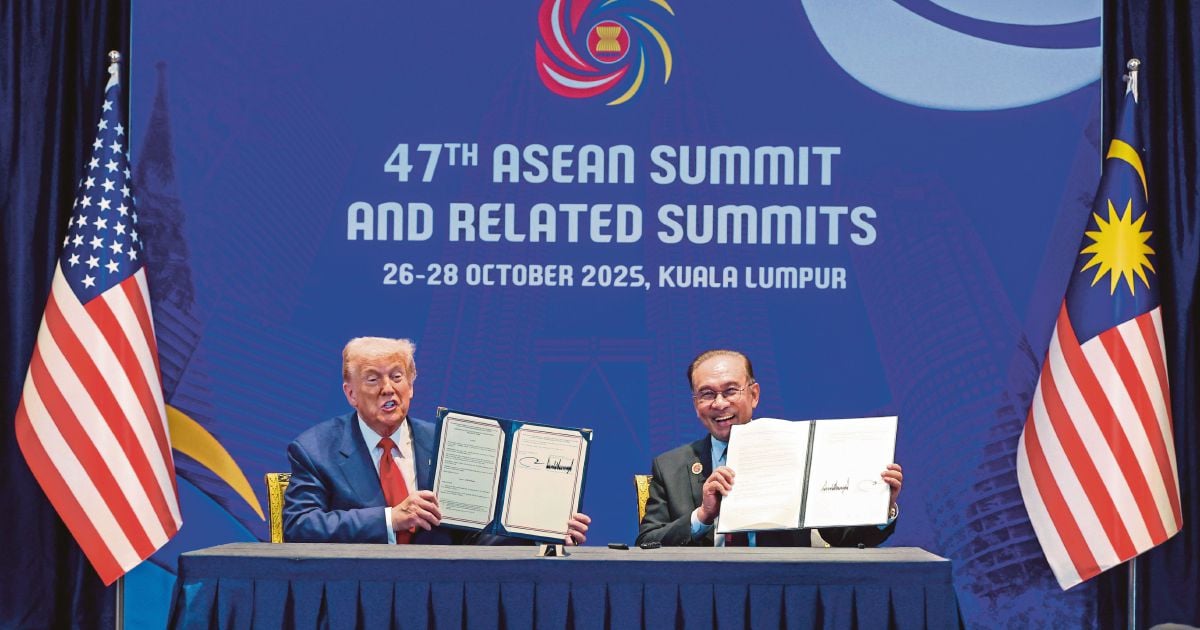
FORMER attorney-general Tommy Thomas recently labelled the US-Malaysia Agreement on Reciprocal Trade as “the worst agreement since Merdeka”.
It is a bold accusation, but one that does not reflect the actual legal structure of the agreement or Malaysia’s sovereign strength.
Our national discourse must be grounded in facts and an understanding of Malaysia’s place in today’s world, not outdated geopolitical anxieties.
One of the fundamental flaws in Tommy Thomas’ critique is that it remains rooted in a Cold War world view, where cooperation with one major power is assumed to mean hostility towards another. This binary logic does not reflect the modern geopolitical landscape.
The world today is no longer unipolar. It is multipolar with multiple centres of influence, including China, the United States, India, the European Union, Japan, Turkiye and other regional powers. As a confident middle power, Malaysia’s strength lies in its ability to navigate among these centres — building balanced, pragmatic and strategic relationships.
Cooperation with the US does not diminish Malaysia’s ties with China; rather, it demonstrates Malaysia’s ability to engage multiple partners in a multipolar era.
Tommy’s interpretation fails to appreciate this geopolitical transformation.
Malaysia is a global semiconductor hub, an influential Asean actor, and an increasingly respected diplomatic voice. A country with such standing must engage with the world, not retreat into isolation or fear-driven narratives.
A significant portion of Tommy’s argument pivots on the use of the word “shall” in the agreement. However, in international law, “shall” does not always impose rigid legal obligations.
Its meaning depends on context and structure. In many diplomatic instruments, “shall” expresses cooperative intent or procedural commitments — not compulsory mandates.
Moreover, the agreement does not provide any enforcement mechanism or tribunal that can compel Malaysia to act against its interests. Therefore, interpreting “shall” as a surrender of sovereignty is inconsistent with the nature of the agreement.
The agreement does not bind Malaysia to foreign jurisdictions, alter the Federal Constitution, force Malaysia into US sanctions policy, or affect Petronas.
Malaysia retains absolute control over its domestic and foreign policy decisions.
Global economics is shifting rapidly. Nations that fail to engage strategically risk being left behind. This agreement positions Malaysia advantageously in high-value industries and global supply chains.
Malaysia’s engagement with the US does not undermine its equally strong relationship with China.
In a multipolar world, successful nations build multiple strategic partnerships, not exclusive alignments. To suggest that Malaysia was out-negotiated is to underestimate the competence of our civil service, legal teams, and diplomats who have decades of experience.
The agreement is not a capitulation. It is a sovereign decision taken with economic foresight and strategic clarity. Malaysia is not being drawn into any bloc. Malaysia is stepping forward in a multipolar world — deliberately, confidently, and on its own terms.
* The writer is a lawyer and a former Member of the Dewan Rakyat and Dewan Negara, Parliament of Malaysia
© New Straits Times Press (M) Bhd