
I DID little research before setting off, preferring instead to let my mind wander upon arrival. The nose-pointed train glided effortlessly forward and, almost before I realised it, the iconic city famed for its Dragon Well (Longjing) green tea was already there, beaming at us through the windows of the packed carriage. The train departed and arrived precisely on schedule, an impressive feat given the sheer throng of passengers converging on the transport hub.
The air is chilly but never damp. A brisk gust of wind greets the passengers as we disembark, each heading off toward different destinations. Finding the metro station is straightforward if you keep your bearings, with clear announcements before every stop in Mandarin followed by English.
Route maps line the inner walls of the train for added reassurance. It feels much like taking a metro anywhere else, except that all bags must pass through security scanners before entering the stations.
It is well past 2pm by the time I finally reach my destination, having pieced the journey together through a combination of metro and bus. The hilly terrain, framed by thinning forests where tall, slender ginkgo trees mingle with bamboo groves, only deepens my resolve to explore further.
Buses arrive almost in unison, easing into their designated parking spots as passengers disembark without fuss. The walk ahead is a pleasant one, the air noticeably fresher, even if slightly thinner. Many visitors move along the same path, while others are already heading back towards the waiting buses.
A short, unhurried walk is all it takes to locate the entrance. An unmistakable sense of anticipation builds as I thread my way through a crowd that is steadily growing. I have no clear expectations — and perhaps that is precisely where the real adventure begins.
RISE AND FALL OF DYNASTIES
[[nid:1341629]]
A sprawling, solitary limestone hill, strikingly distinct from the surrounding mountains, rises to greet me. Scattered across its surface are distinctive rock carvings — some finely detailed, others bold and robust — each bearing the artistic imprint of different dynasties.
The rise and fall of dynasties is a familiar rhythm in human history, yet the religious narratives they leave behind often differ in the most subtle ways. It is said that these much-celebrated carvings span an extraordinary five dynasties and 10 kingdoms, shaped patiently over countless centuries.
[[nid:1341628]]
The intricate carving of the Laughing Buddha — smiling Milefo, or Maitreya Buddha — seated in relaxed repose with a string of oversized prayer beads clasped in his left hand, is nothing short of majestic. His round face and unrestrained smile seem to reach into your very soul, unleashing a quiet surge of joy, while his eyes radiate warmth and contentment.
It is an image of simplicity, serenity and unbroken happiness, carved directly into the limestone hill during the 10th-century Song dynasty as part of its enduring façade.
The carvings here are distinctive and startlingly lifelike, though some remain hidden unless one carefully navigates a winding, uneven path, hands braced against the cave’s natural walls for balance. Among them is a striking sculpture etched into the rock, resembling a group of eminent monks embarking on a sacred pilgrimage to India in search of Buddhist scriptures.
[[nid:1341627]]
These artistic treasures carved into the limestone hill are collectively known as the Feilai Feng Grottoes, or “The Peak That Flew Here.” Legend has it that the Indian monk Huili, upon discovering the site in the fourth century, was so struck by its resemblance to a sacred peak in India that he exclaimed, “When did the peak fly over here?”
Feilai Feng only deepens one’s admiration for the monumental efforts taken to preserve such fragile masterpieces, which have borne witness to the rise and fall of countless dynasties across China. Despite an unforgiving climate and repeated attempts at destruction over the centuries, these grottoes continue to defy time and adversity, standing today as a truly timeless treasure.
IMPERIAL INFLUENCE
[[nid:1341626]]
After a much-needed breather, I continue with a slow, steady walk amid a swelling crowd, setting the stage for the next climb. The elevated pathway does little to dampen the urge to press on, though a brief detour to the right of the main route offers a rare glimpse of a site steeped in history and reverence.
The imposing structure reveals itself through an all-encompassing triple grey-tiled, eaved roof — an architectural statement crowned with ornate ridges — and a large inscribed plaque bearing the temple’s name in Chinese characters, prominently positioned above the intricately carved main door.
Its walls, painted a vibrant sunflower yellow, reflect unmistakable imperial influence, symbolising the highest honour bestowed by emperors and affirming the temple’s status as a royal household sanctuary.
Entering the Grand Hall of the Great Sage allows you to come face to face with the towering Sakyamuni Buddha, made of camphorwood in its entirety yet fully coated with a thin layer of gold.
Seated serenely on a layered lotus flower throne, it still reaches a phenomenal height of 24.8m, representing the embodiment of Mahayana Buddhism, its teachings pervasive within the fabric of society for the longest time.
[[nid:1341625]]
This iconic temple, Lingyin, was founded by the Indian monk Huili in 328 AD during the Eastern Jin Dynasty, making it an astonishing 1,700 years old. Its founding coincided with a turbulent period in the Roman Empire, when Constantine I oversaw the construction of the formidable Constantinople, while King Shapur II ruled Persia amid inevitable clashes between the two powers.
Right behind the towering Sakyamuni Buddha, I am captivated by a vast, intricately carved wall facing the northern side of the temple. The scene is so breathtaking that time seems to stand still, and I am filled with awe at the meticulous detail of the camphorwood carvings, which depict celestial guardians and warriors set against the mythical Mount Potalaka.
[[nid:1341624]]
At the centre stands a radiant statue of Guanyin (Avalokitesvara), gracefully poised atop a large fish with a dragon’s head, its relaxed eyes and curling whiskers exuding calm. The fish’s cinnabar-red scales, edged in bronze, complete the vivid composition.
Gilded in gold, Guanyin leans forward with compassionate eyes, projecting an aura of serenity that envelops the temple as devotees kneel, clasp hands, close their eyes, or gaze upward in reverence.
On her right stands the humble youthful pilgrim Shancai Tongzi, a devoted seeker of guidance from 53 spiritual teachers, with Guanyin as the 28th and most revered. To her left is the Dragon’s daughter, Longnu, who has attained instant enlightenment, completing this extraordinary tableau of devotion and grace.
SYMBOL OF GREATNESS
[[nid:1341623]]
In another striking scene, a woman offers prayers holding a lit lotus flower, sharing that she once dreamed of Guanyin standing atop a dragon-headed fish gliding through the vast ocean. Devotees wait patiently for their turn, while a steady stream of worshippers continues to arrive, all hoping for a glimpse of the breathtaking images adorning the wall.
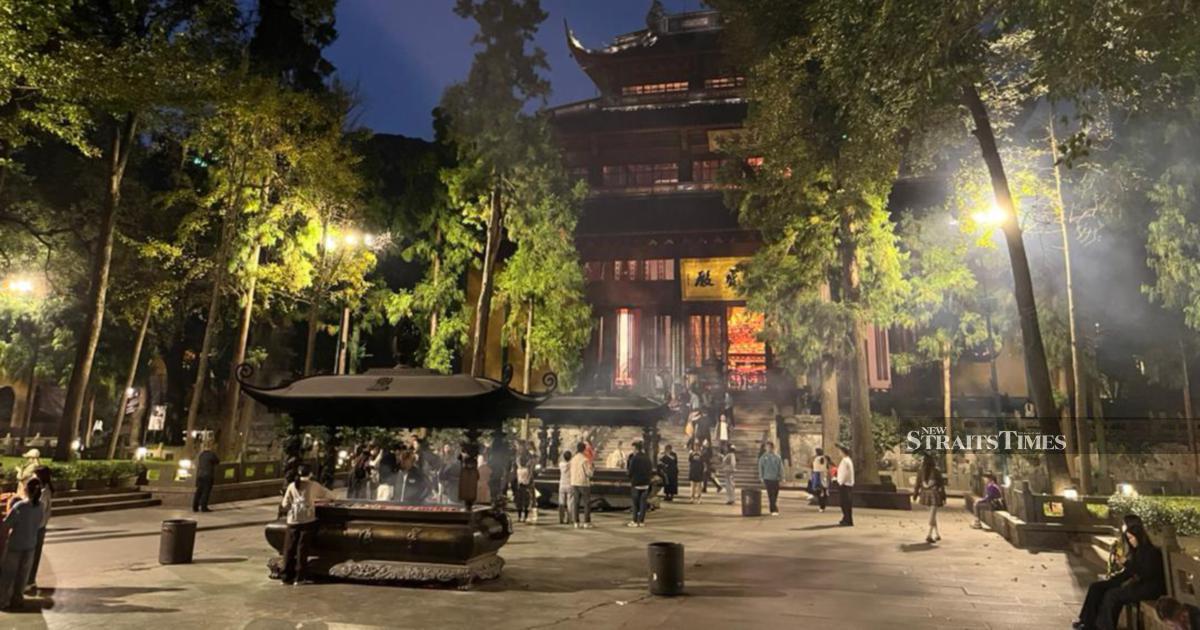
By the time I make my way to the other temples perched on higher ground within the sprawling Lingyin complex, it is well past 5pm, and I realise I have only explored a fraction of the vast site.
A gentle melody, likely from a guzheng, drifts through the cool evening air as the sun quietly dips below the horizon. The temples remain majestic even as shadows lengthen under the streetlights, and the crowd gradually thins — some rushing to catch the last buses, others opting for the increasingly popular ride-hailing services.
[[nid:1341622]]
A quiet sense of accomplishment settles over me as I soak in the serenity of the approaching night. The lingering melody evokes memories of a poignant scene from Romance of the Three Kingdoms, the epic tale chronicling the warring states of Wei, Shu and Wu in their quest for supremacy.
One of the most striking episodes features Shu’s military advisor, Zhuge Liang, fondly known as Kongming, trapped and heavily outnumbered in the miniature city of Xicheng, with Sima Yi’s Wei forces rapidly approaching.
Perched atop the city’s entrance gate, Zhuge Liang remained composed, a guqin — the seven-stringed zither — set firmly before him. He instructed a handful of soldiers to disguise themselves as peasants, sweeping the streets with casual diligence, masking the presence of the incoming enemy.
With eyes closed, Zhuge Liang plucked the strings of his guqin, each note radiating calm and control, a serene melody that seemed to freeze the tension around him despite the imminent danger.
[[nid:1341621]]
Sima Yi halted his troops, struck by the music that seemed to flow through him, and realised an ambush lay hidden behind the city walls. Obeying his command, his valiant soldiers retreated, leaving the city untouched.
Lingyin Temple — fondly known as the Temple of Soul’s Retreat — has been destroyed and rebuilt countless times throughout its long history, with landmark restorations during the Qing dynasty. Each reconstruction was meticulously planned and executed, ensuring Lingyin remained a cherished cultural and religious landmark in Hangzhou and across China.
The temple stands as a testament to the greatness of the past, crafted by architects who trusted that future generations would understand the true meaning of a home only if history is honoured. This venerable Buddhist temple embodies resilience, a whisper of the past that carries the promise of a brighter tomorrow.
Tan Bok Hooi conducted his theoretical research on Higgs boson and is an author of six books (English and Malay). He established LIVEFREE, focused in healthcare recruitment and consultancy.
© New Straits Times Press (M) Bhd