THE temple rises into view every time I turn into Teluk Pulai, a familiar constant in a landscape that has changed in small, insistent ways. It is one of the few sights that still tells me I am home.
As far back as memory stretches, the Klang Subramania Swamy Temple has stood there, unmoving, a silent signpost marking the place where childhood unfolded and growing up took root.
I remember my sister taking up Bharatanatyam classes at the temple hall, the tai-takkatei-takkatei chants filling the space as her feet struck the floor in time. The teacher’s small wooden stick marked the talam, its sharp tap-tap keeping the dancers anchored to the beat as steps were drilled and syllables recited.
I remember my childhood best friend, Gunamalar Mahadevan. We were both 7 when she first took me to the temple hall. I hovered at the side, watching her perform kucheri recitals and sing Carnatic music, before trailing after her into the temple itself. There, worship felt different — bells ringing, hands clasped above heads, the air thick with incense — a Christian child tagging along and taking it all in.
[[nid:1368960]]
But like all things, change is inevitable. My sister eventually stopped her dance classes when her interest waned, and Guna and I grew up and drifted apart. She would go on to settle down in India while I remained here in my not-so-little hometown, growing more wistful as the years passed.
That same change has settled over Klang, reshaping streets, shops and places I once thought permanent. Even the temple was not spared. Taken down brick by brick and rebuilt, it now bears a different face.
[[nid:1368959]]
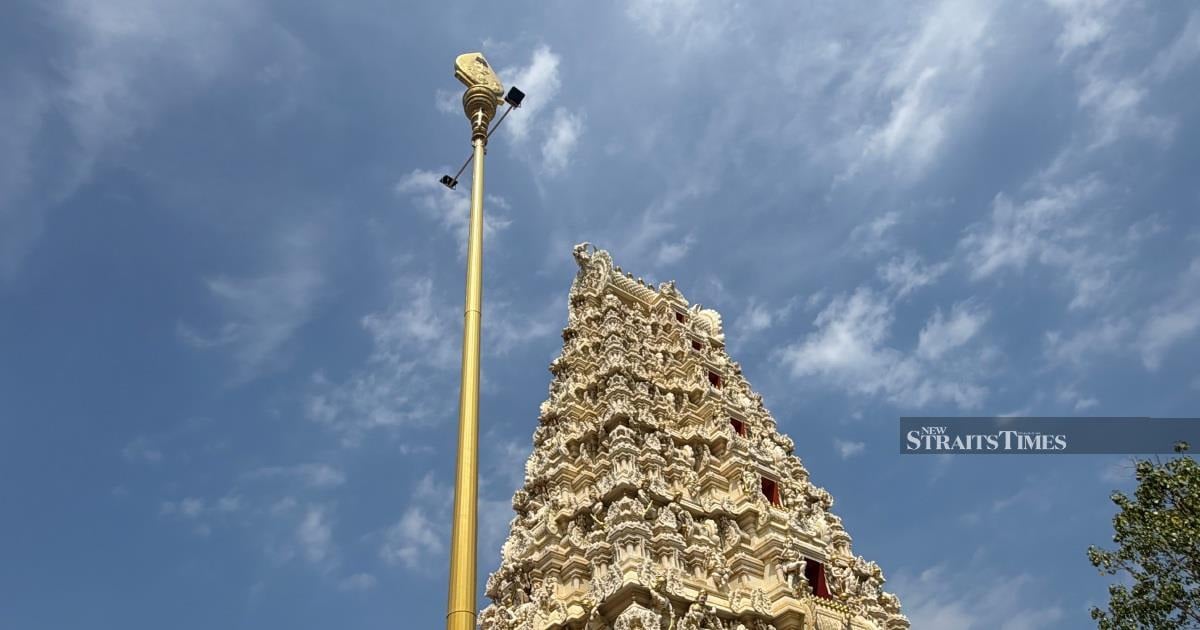
The once-colourful raja gopuram, the temple’s main tower, rises over 26 metres and is now pale in ivory. Beside it stands Murugan’s Vel, a tall, skyward-reaching pole in gold, serving as a marker of wisdom and protection in a town learning, again and again, how to change.
It is late morning when I drive into the temple grounds. With Thaipusam approaching, I find myself wanting to learn more about this Murugan temple and the deity it honours.
Thaipusam is closely linked to Murugan and deeply connected to temples dedicated to him.
The festival is inseparable from Murugan himself. It recalls the moment he received the Vel from his mother, Parvati — the divine spear he would later wield to defeat evil. For devotees, Thaipusam is a time of vows, endurance and spiritual discipline.
While thousands gather at Batu Caves for Thaipusam, this temple feels different. Here, the observance is quieter and more personal, shaped by familiarity and community.
OF REUNIONS AND COMMUNITY
[[nid:1368958]]
It was the same sense of community I encountered when I first reached out to ask if I could visit the temple and learn more about this touchstone in Teluk Pulai. The response was immediate and generous.
Yes, I could come. Yes, I could take photographs and videos. There would be people to welcome me and show me around. After all, the temple has long opened its doors to all.
The feeling was familiar. It was how I felt years ago when Guna took my hand and led me into the temple for the first time.
As I walk towards the entrance, a bespectacled woman with a serious expression approaches, her arms filled with records and files. Something about her face stops me in my tracks. Then recognition sets in. It is Guna’s sister, Punithamalar.
The 57-year-old lawyer recognises me at once and we exchange a brief hug. It feels fitting that she would be the one to usher me into the temple after all these years.
She is accompanied by long-time members of the temple community, S. Chandran, 57, and K. Rajasuriar, 85.
Together, we enter the main prayer hall shortly after 11am. The space is airy and open, with sunlight and breeze moving easily through it. The temple has several sanctums, but the main sanctum — which houses the granite effigy of Murugan — is closed.
It will reopen later in the evening, in keeping with prayer timings. Only a handful of devotees remain, lighting oil lamps and offering prayers as we sit on a bench at the side.
[[nid:1368957]]
Though rebuilt, the temple today looks markedly different from its early days. Much of what once defined its physical form has changed, but it continues to carry a strong sense of community rooted in its origins, closely linked to the Sri Lankan Tamil families who settled in Teluk Pulai from the late 19th century onwards.
Many were brought in by the British to serve in administrative, educational and technical roles, and went on to play a key part in the development of Port Klang, then known as Port Swettenham.
Over time, these families established themselves in areas such as Teluk Pulai, Jalan Dato Amar, Jalan Raja Muda and Riverside Road. Between 1945 and 1955, Teluk Pulai saw rapid growth, earning it the nickname Chinna Yaalpaanam or Little Jaffna.
HUMBLE BEGINNINGS
[[nid:1368956]]
The temple’s earliest records date back to 1912. At the time, a sathu or temple attendant named Kentaga Parthesi owned a Vel, which he worshipped daily. This Vel was later placed at the southern end of what is now the temple grounds, in the home of a woman known as Madam Kugavinthamma.
[[nid:1368955]]
“You have to understand that the community was not wealthy in those early days,” recounts Punithamalar, adding: “Granite statues of deities are usually carved in places like Mahabalipuram, India, where there is a long tradition of stone carving. Bringing in such a statue was beyond the community’s means then. So, the simple lance, the Vel, which is central to Murugan, became their focus of worship.”
In time, and with the consent of Madam Kugavinthamma, members of the Tamil community in Teluk Pulai came together to build a temple to properly house the Vel. The first kumbabishegam or temple consecration ceremony was held in 1924.
Built by the community, the temple became more than a place of worship. It also served as a space where people gathered in moments of faith and uncertainty.
[[nid:1368954]]
For Chandran, the temple’s role during difficult periods is captured in early newspaper reports from the 1940s that he carefully preserves. These describe special pooja ceremonies held during World War 2, where devotees prayed for strength and resolve.
“The prayers were for steadfast determination,” he shares, adding: “They asked that Great Britain and her allies be given the strength to continue the struggle against the Japanese until victory.”
LEARNING GROUND
[[nid:1368953]]
As the community put down roots in a country far from their own, there was a deep need to hold on to what defined them. Keeping the Tamil language alive became part of that effort.
In 1937, a school was established on the temple grounds, ensuring that the mother tongue had its place alongside English — not just as a means of communication, but also as a way of preserving culture, identity and a way of life passed carefully from one generation to the next.
Over the decades, the school served generations of families, giving hundreds of students a grounding in language, culture and learning. It is a legacy Chandran is keen to show. He produces a copy of a school-leaving certificate dated 1955, belonging to a woman named Devi Krishnan.
“She went on to train as a teacher and later retired as the headmistress of Sekolah Jenis Kebangsaan (Tamil) Persiaran Raja Muda Musa, then known as Watson Tamil School,” he says, a note of pride in his voice.
[[nid:1368952]]
In time, the temple school closed as education became standardised under government policy, marking another shift in how the community adapted to a changing nation. Yet the temple continues to function as a centre for the community, hosting regular classes in religion, the Tamil language, yoga and other activities, Chandran adds.
[[nid:1368951]]
Rajasuriar, a retired headmaster, agrees that the temple has long been a place of learning and continues to play that role today. As he speaks about teaching, he mentions his wife in passing.
“My wife was a teacher,” he says.
It is then that recognition dawns. She was my science teacher when I was in Form Two at Methodist Girls School Klang. It feels like another small thread connecting past and present in this place.
PRECISION AND DEVOTION
[[nid:1368950]]
As we sit in the now-empty temple, I ask about its design. Punithamalar explains that the structure follows ancient Hindu texts such as the Vastu Shastra, Shilpa Shastra and the Agamas. These do more than dictate measurements. They shape how the temple is meant to function — as a dwelling for the divine and a space that draws the worshipper inward.
At the centre of the plan is the Vastu Purusha Mandala, a sacred geometric map of the universe, with the main sanctum placed at its heart.
“Nothing here is random,” she says, adding: “Even the number of pillars is planned.” There are 28 in all.
Much has changed with the rebuilding, but not the intent. The original principles were carefully preserved. Proportions, layout and orientation remained intact, even as materials were renewed. The temple may look unfamiliar now, but beneath its new surface, it still follows the same sacred order that guided its beginnings.
[[nid:1368949]]
At the heart of this temple is the deity it is dedicated to: Lord Murugan. For Sri Lankan Tamils, Murugan has long been, and remains, a deeply revered figure, often regarded as Tamil Kadavul — the God of the Tamils. This devotion is not merely theological, but cultural, shaping identity, ritual and community life across generations.
That enduring reverence is anchored by some of Sri Lanka’s most ancient and important shrines, from Kataragama in the south, to the Nallur Kandaswamy Temple in the north and Trincomalee in the east — each standing as a testament to Murugan’s central place in Tamil spiritual and cultural life.
[[nid:1368948]]
As Thaipusam approaches, temple representatives stress that the festival is observed in Murugan temples everywhere, not just at Batu Caves. Here in Teluk Pulai, the hope is for a celebration grounded in devotion rather than spectacle.
Central to Thaipusam is Idumban, revered as a devoted follower of Murugan and guardian of his temples, particularly at Palani. According to tradition, Idumban carried two hills, Sivagiri and Shaktigiri, balanced on a yoke known as a kavadi. This act gave rise to the Kavadi Aattam or burden dance. Today, devotees carry kavadis, often bearing milk pots, to fulfil vows and seek Murugan’s blessings.
The true meaning of Thaipusam, insists Chandran, lies beyond ritual or endurance. It is the sincerity of worship, offered from the heart, that holds the greatest value.
CELEBRATION AND PRAYER
[[nid:1368947]]
I am invited back to the temple at 7pm that evening, when the sanctum reopens and the evening rituals begin. This time the hall is fuller. The smell of incense hangs in the air and the sound of the nadaswaram and melam fills the space as devotees gather for Karthigai, a monthly festival closely associated with Murugan, symbolising the triumph of light over darkness and knowledge over ignorance.
Here, the observance centres on an inner-court procession for Lord Muthukumaraswamy, a form of Murugan worshipped at the temple.
A young woman plays the thavil, smiling as she works, her fingers fitted with thimbles, striking the drum in steady rhythm.
[[nid:1368946]]
When the priest lifts the flame and circles it before the deity, the light briefly catches faces turned towards the sanctum. Later, Lord Murugan is carried reverently around the temple by several men in veshtis, followed by devotees, prayers and the steady rise of music. Above it all, the deity presides over decades of worship unchanged by a changing world.
[[nid:1368943]]
When the procession finally ends, life in Klang resumes beyond the temple gates. Streets look different, people have moved on and the town has grown in new directions.
Yet this temple remains a place of return, shaped by its community and sustained by belief, a reminder that while much changes, faith and the ties that bind this community endure.
© New Straits Times Press (M) Bhd