LETTING the winds decide one’s fate may seem foolhardy to most. For Fabian Fernandez, the winds became a compass.
Aboard his boat Destiny 12, he learnt to read them, guided by research, science and a firm belief that if you commit fully to a journey, a way will open.
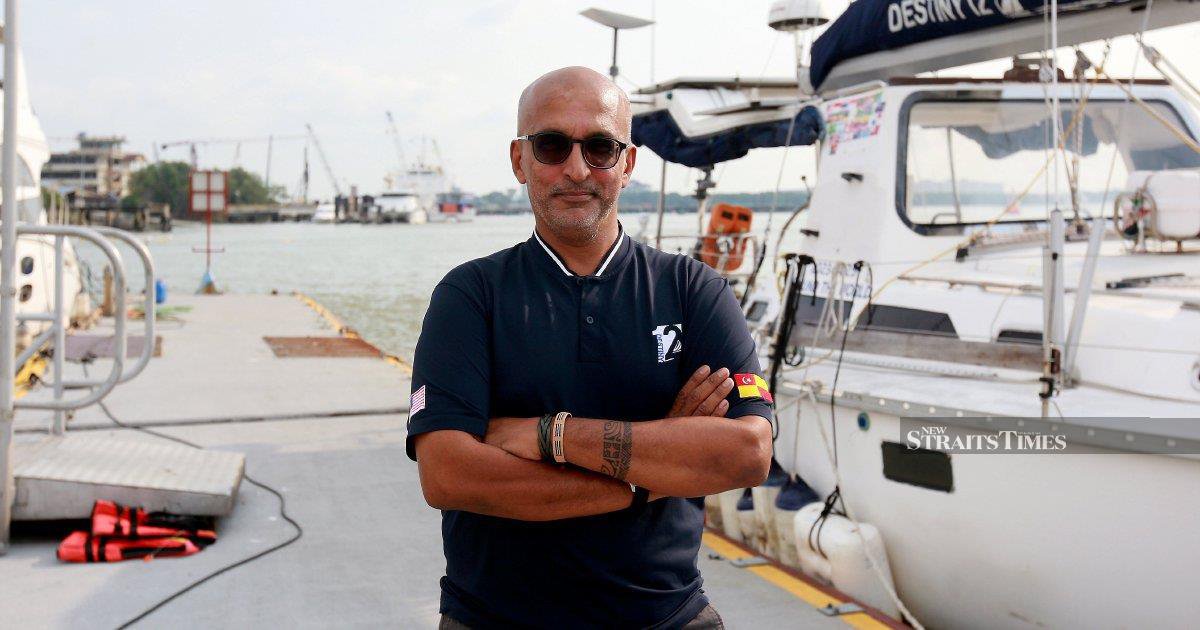
When Fabian set sail on Feb 6, 2023, he began a voyage that would carry him across oceans and around the world. On Oct 13 last year, his boat surged into Port Klang, completing a solo circumnavigation and making him the fourth Malaysian to achieve the feat.
[[nid:1363979]]
The former marine engineer and plantation manager stepped ashore at the Royal Selangor Yacht Club’s outer pontoon to a hero’s welcome. He was greeted by Tengku Amir Shah Sultan Sharafuddin Idris Shah, the Raja Muda of Selangor, marking the end of an extraordinary 2½-year odyssey.
[[nid:1363978]]
His eyes glint as he recalls the moment. “It wasn’t easy,” he admits simply, as we sit at the club overlooking the water.
Midway through the conversation, he gestures towards his boat. Destiny 12 bobs quietly at its berth among much larger vessels. Modest in size, it bears the signs of its long passage. Flags from ports and countries he visited line the railings, their colours mapping the distance he travelled.
When I remark on how long the journey took, Fabian is quick to clarify: “You can’t sail all year round. When you sail by wind, the wind decides. For a voyage like mine, timing was everything. I moved only when the prevailing winds were in my favour.”
NO LOCAL EXPERTISE
[[nid:1363977]]
When people hear the word circumnavigation, many imagine the sailing itself and little else. What they often do not see is the work that begins long before a boat ever leaves the harbour.
Says Fabian: “There’s a lot of planning and preparation that goes into this. At sea, everything can turn against you. Weather, wind, currents. The environment doesn’t care who you are.”
But the physical challenge, explains the 54-year-old, is only one part of the equation. Unlike many long-distance sailors, he had no sponsors or external funding. Every decision, from provisioning to routing, had to be planned within his own means.
[[nid:1363976]]
He also carried the burden of planning the voyage alone. Fabian charted every route himself, relying on extensive reading, research and conversations with foreign sailors.
Understanding weather systems, seasonal windows and ocean currents was critical. These were not skills readily available locally, and there was no one in Malaysia he could consult on key sections of the journey.
Years of preparation followed. Most vessels heading west take the safer route through the Suez Canal into the Mediterranean, avoiding the Cape of Good Hope altogether. Fabian did not.
He had crossed the Cape once before on a merchant vessel, travelling east. This time, he did it alone, in the opposite direction, on a much smaller boat. “Both times I was lucky,” he admits.
He is careful not to romanticise it. “If you time it wrongly, it can have serious repercussions.”
SAILING WITH THE WINDS
[[nid:1363975]]
The challenges were immense.
The most formidable test came early, when a shift in timing pushed him into one of the ocean’s most feared regions. Fabian became the first Malaysian to sail the east-to-west passage of the Cape of Good Hope and the Mozambique Channel, where the Agulhas Current collides with opposing winds, creating steep, chaotic seas that have damaged even large ships.
At one point, he was forced to shelter in Mozambique for two weeks as severe weather systems rolled through. He recalls: “At first there were four boats. By the end, there were 14. Nobody could move.”
[[nid:1363974]]
If the southern oceans tested his seamanship, the Pacific tested his mind.
It was the longest stretch Fabian spent alone, without a crew. For nearly a month, he crossed the Pacific with no land in sight and no other vessels on the horizon. Communication with the outside world was limited to brief satellite checks. The horizon never changed. The days blurred into one another.
From the outset, assembling a crew was never straightforward. There were no sponsors backing the voyage, and finding local sailors willing to commit to long ocean passages proved difficult. Fabian did not set out to sail solo, but circumstances often dictated otherwise.
Over time, he managed to find individuals who joined him on different legs of the journey. The Pacific, however, was a crossing he chose to make alone. “When there’s no white noise out there,” he reveals, “you’re left with yourself. That’s when I grew closer to God.”
Being alone also meant there was no one else to step in when things went wrong. That reality became starkly clear when a sail tore mid-ocean. A repair that would normally take two people took him four exhausting hours. He wrestled heavy, flapping canvas on a violently pitching deck, bracing himself to stay upright while working.
Experiences like that came to define his approach to the journey. “That’s how sailing has always worked,” he reflects. “You don’t force it. You respect the sea and deal with what comes.”
HUMBLE BEGINNINGS
[[nid:1363973]]
We sit looking out at the water as the boat rises and falls gently at its berth, ropes creaking softly. Fabian’s gaze lingers on the blue-grey sea, a trace of wistfulness crossing his face.
Says Fabian: “I was born on a Thursday. You know that old rhyme — a Thursday’s child has far to go. My late mother used to quote that all the time and she believed I would travel far.”
He grew up in a small town in northern Perak, the middle of three brothers in a typical working-class family. His father worked as a school clerk in the civil service, while his mother was a homemaker.
As a boy, he was fascinated by jets and dreamed of joining the air force. That ambition ended at 13, when he had to start wearing glasses.
“That was the end of flying,” he chuckles, adding: “I also considered well… maybe law then.”
That, too, proved impractical. His elder brother was already studying at a public university, and supporting two sons at the same time would have strained the family’s finances.
The turning point came through a former classmate who suggested marine engineering. The course offered a scholarship and a guaranteed job upon graduation.
“At that point, it sounded like the sensible choice,” Fabian recalls.
SEAFARING YEARS
[[nid:1363972]]
His first real encounter at sea came in 1992, when he was posted as a cadet aboard the MV Alam Aman. At about 180 metres long, it was the largest vessel he had ever seen.
For someone new to the sea, the scale alone was overwhelming. He still remembers stepping into the engine room for the first time. Recalls Fabian: “I just stood there and stared. I had never seen anything like it.”
The sea, he discovered, offers no guarantees. “It can be calm like a lake, then turn on you,” he reflects. Nights under star-filled skies brought constant perspective. “That’s when you realise how small you are. It changes you.”
In 1998, seeking a more stable future, Fabian left the marine industry and moved into the plantation sector, where he would spend the rest of his working life. Sailing slipped into the background, overtaken by responsibility and routine. For years, it barely crossed his mind.
That changed in 2014.The father-of-two found himself back at the Royal Selangor Yacht Club, a place he vaguely remembered from childhood. This time, he joined without expectation. He recalls: “There was no thought of owning a boat. Definitely no thought of sailing around the world. It was just curiosity.”
He signed up for basic sailing courses and spent more time on the water. Before long, he began thinking about having a boat of his own rather than borrowing one.
He bought a small, ageing boat and renamed her Freedom 12. It was a modest step, taken without ambition or long-term plans, but it marked the point when sailing returned to his life.
BUCKET LIST
[[nid:1363971]]
Years later, he would buy his second boat, Destiny 12, and was racing regularly. Preparations were underway for a regatta, possibly in 2018, when fate intervened.
In December 2017, tragedy struck his family. His sister-in-law died suddenly at the age of 42 while on a cruise with her family. The loss devastated them all. Fabian had watched his brother and sister-in-law navigate years of hardship together, only for her life to be cut short at its peak. “That changed something in me,” he reflects. “It showed me how fragile life really is.”
The shock lingered. At 46, he found himself thinking differently about time and purpose. He muses: “We take so much for granted. We think there’s time. Then suddenly there isn’t.”
Not long after, a friend mentioned a film about two men confronting mortality and deciding to live deliberately with the time they had left. The idea stayed with him. “That was when I started thinking,” Fabian says, adding: “Maybe it was time I made my own bucket list.”
The idea took shape slowly, through time spent on the water and long stretches of thought. By then, Destiny 12 was no longer just a racing boat. She had become a place of testing, learning and reckoning.
Shares Fabian: “At some point, I realised I didn’t just want to sail around the harbour. I wanted to see how far I could really go.”
FACING THE ODDS
[[nid:1363970]]
In 2019, an incident at work became the push he didn’t know he needed. He was passed over for promotion, and with it, the long-held idea of rising to the top of the company fell away. At the time, it stung. Only later did he recognise it as a catalyst.
“I realised I was chasing something that no longer mattered to me,” reflects Fabian.
For more than two decades, he had built his career in the oil palm sector. Walking away was not an easy decision. There were mortgages to pay and two children to raise. The questions were immediate and relentless. If he left, what would he do next?
But the sense of life’s fragility, sharpened by earlier losses, would not loosen its grip. Time, he felt, was not something to be deferred indefinitely. “I knew I had to find a way to do the things that mattered to me,” he says.
By then, the idea of a circumnavigation was no longer abstract. The practical questions followed fast: funding, timing, preparation… Yet much of the groundwork had been laid. Major upgrades to Destiny 12 had been completed in 2017 and refined further by 2019. Slowly, the idea shifted from improbable to possible.
“I remember thinking, maybe I actually could do this,” Fabian recounts.
What remained was the hardest part: turning intent into action. Fresh from completing the largest project of his professional career, he realised the skills he had honed — planning, risk management, logistics — were precisely what the journey would require.
From there, the approach became methodical. The principles were clear: fix a departure date, map the route, prepare the boat, work out the costs and build a reliable support structure. It was no longer just a dream.
The plan to sail around the world had begun.
CONQUERING GOALS
[[nid:1363969]]
As we walk along the pontoon towards Destiny 12, Fabian slows, clearly at home here. He gestures towards the boat, pointing out the changes he made over years of preparation.
The chart plotter was upgraded, along with the AIS — a system that allows vessels to identify and track one another — as well as radar and wind instruments. A new 3D depth sounder was installed, and the autopilot drive system replaced with one he trusted completely.
He explains: “Out there, you’re on your own. These are not luxuries. These are what keep you going when you’re tired, when visibility drops, when there’s no one else to rely on.”
None of it was done in one go. He raised the funds himself, saving steadily and making careful trade-offs along the way. There were no sponsors and no shortcuts. Every upgrade, every repair, every mile sailed was earned. “This didn’t happen overnight,” he insists. “It took years.”
Doubt, however, was a constant companion. Growing up in a family that was not well to do, he became familiar with being underestimated. Shares Fabian: “People look down on you. They tell you things like, you’re not good in maths, you won’t amount to anything.”
What struck him was how little that changed. Even as he prepared to leave, the doubts resurfaced. “Two days before I set off, people were still telling me I couldn’t do it.”
Standing beside Destiny 12, those voices no longer matter. “At some point, you realise you can’t live your life based on what others think you can or can’t do,” he says. “You prepare, commit and then you go.”
[[nid:1363968]]
While he may have beaten the odds to sail with the wind, Fabian is now charting a different course.
He wants his 32-month journey at sea — including a single prolonged stretch of isolation that tested his discipline and resolve — to count for something beyond a personal milestone.
It was also a journey that required courage and sacrifice, from long periods away from his family to committing his own funds to fulfil a long-held goal on his bucket list.
The next chapter, he explains, is about sharing what the experience taught him through public talks, a book on his circumnavigation and the launch of Dream Network, a platform focused on training, motivation and personal development.
He says: “I want people to understand that nothing is impossible. Not if you’re willing to prepare, commit and keep going when it gets uncomfortable.”
For Fabian, the message is simple and hard-earned. Dreams do not arrive fully formed. They’re built slowly, often in doubt, often in solitude and almost always against expectation.
As he looks ahead, the horizon remains open. The sea still calls. And once again, he’s content to let the wind decide the timing, trusting it to carry him where he needs to go next.
Foolhardy, you say? I think not.
© New Straits Times Press (M) Bhd