
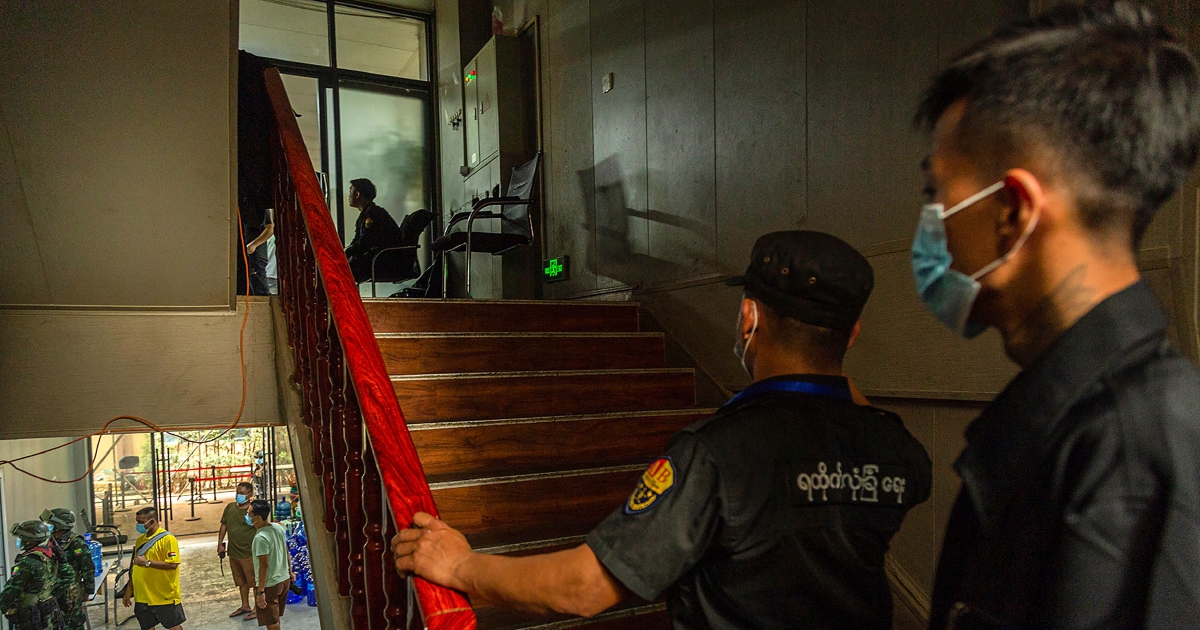
A DAY after Myanmar’s junta leader visited the southeastern city of Hpa-An last week, two sources said army officers met members of a powerful local militia with a directive: they had to suppress burgeoning scam centres on the Thai-Myanmar border immediately.
Online scam operations along the frontier are part of Southeast Asian criminal networks spanning countries including Myanmar and Cambodia that generate billions of dollars every year by defrauding people across the world, often using human trafficking victims.
At Sunday’s meeting, officers told members of the Karen National Army (KNA) — sanctioned in May by the United States Treasury Department for facilitating cyber scams, human trafficking and smuggling — that the instructions had come directly from junta chief Min Aung Hlaing, according to two sources aware of the discussions.
“(Min Aung Hlaing) met with military officials and stated that the scam centre issue was severely damaging the country’s international reputation,” said one source.
“He urged them to carry out an aggressive crackdown before the election,” the source added, referring to the junta’s multi-phase general election, starting on Dec 28, which has been widely derided as a sham to perpetuate the military’s control.
Last week’s announcement of a new US government “Strike Force”, which includes the Federal Bureau of Investigation and the Secret Service, has raised particular concern in Myanmar’s junta, said both sources.
A military official at Sunday’s meeting with the KNA explained that they could not risk US teams crossing the border to start investigations, said one source, describing him as saying: “We must solve the problem ourselves.”
Reuters is the first to report details of the internal discussions within the secretive Myanmar military, which signal that, after years of allowing scam centres to gain ground, the junta is bending to growing international pressure.
Unlike other ethnic militias in the country, the junta has close links with the KNA, which the US has said is actively involved in the scam centres.
A junta spokesman did not respond to calls seeking comment. Recently, Myanmar state media reported that Min Aung Hlaing had told military commanders at a regional headquarters to “eradicate” scam centres “as a national responsibility” but did not give details.
Naing Maung Zaw, a KNA spokesman, however said the militia led the crackdown and the military joined the operation after being informed of the action.
“Our leader decided that cooperating with the military might make some processes smoother,” he said.
“These operations are led by us.”
Scam operations in Southeast Asia originated from loosely regulated casinos and online gambling beginning in the 1990s, but rapidly expanded during the Covid-19 pandemic as criminal groups sought new sources of profits amid lockdowns and strict border controls.
Shwe Kokko, a major scam compound in Myawaddy, was set up in 2017 by the Hong Kong-registered Yatai International Holdings Group and a precursor of the KNA, initially advertised as a casino destination, according to the US Institute of Peace.
The company has denied involvement in criminal activities, including human trafficking.
After years of expansion, Myawaddy’s scam compounds came under the spotlight in January, following the high-profile abduction and release of a Chinese actor in Thailand that sparked a multi-national effort to dismantle the businesses.
But the Myanmar military government largely stayed on the sidelines, saying it had limited authority in far-flung border areas — until now.
Jason Tower, a senior expert at the Global Initiative against Transnational Organised Crime, said the US announcement of the multi-agency “Scam Centre Strike Force” to dismantle the compounds was the game-changer.
Last week, Thailand extradited gambling kingpin She Zhijiang, who previously headed the Shwe Kokko complex, to China at Beijing’s request. He was arrested by Thailand in 2022.
“Two global powers pushing for a crackdown puts the Myanmar military and its BGF (Border Guard Force) in a difficult position,” said Tower, referring to the KNA by its previous name.
“The Myanmar military likely now sees increasingly clearly that more and more members of the international community are mobilising to address the massive threat to global security that the scam centres present.”
© New Straits Times Press (M) Bhd