ON some mornings in rural Johor, before the school bell rings and children’s voices spill into the corridors, Dr Gomathy Sankaran steps quietly into her science laboratory, pausing to take in rows of plants thriving in hydroponic channels, recycled materials transformed into learning tools and the faint scent of herbs grown by small, careful hands.
To her, these are more than teaching aids. They are living proof that education, when shaped by empathy and purpose, can change lives.
Her journey to this moment did not begin in a well-equipped laboratory or a privileged classroom, but decades ago in Jasin, Melaka, where perseverance was a daily lesson and faith in education sustained a modest household.
The sixth of eight siblings, Gomathy grew up in a family shaped by physical labour and quiet sacrifice.
Her father worked as a tractor driver, while her mother tapped rubber to supplement the family’s income. Life was often hard, but it was never without hope.
“My parents may not have had much, but they were rich in belief,” she recalls, adding softly: “They taught us that education was the only inheritance they could give us. That belief stayed with me, even on days when everything felt impossible.”
Her formative years were spent in SJKT Bukit Rengam, an institution with limited infrastructure and resources. There were no fancy laboratories or digital tools — only chalkboards, worn textbooks and teachers who taught with heart. Instead of restricting her ambitions, the limitations sharpened her resolve.
She found herself drawn to science, fascinated by how simple observations could explain complex realities.
Encouraged by teachers who recognised her curiosity, she began to see education not merely as a personal pathway out of hardship, but as a means to uplift entire communities.
Looking thoughtful, she recalls: “I wanted to be the kind of teacher who could open doors, especially for children like me, from rural backgrounds, who just need someone to believe in them.”
IN PURSUIT OF GROWTH
In 1997, after completing her training at Temenggong Ibrahim Teachers Training College, Gomathy formally entered the teaching profession.
From the outset, she distinguished herself not through accolades, but through commitment.
While many were content to remain within the boundaries of routine teaching, she sought growth — intellectually, professionally and personally.
Balancing full-time teaching with academic pursuits, she earned her Bachelor of Education (Science) in 2009 and subsequently her Master of Education in 2013.
Yet, her most demanding challenge came later: pursuing a Doctor of Philosophy in Educational Technology while managing leadership responsibilities, innovation projects and family life.
In 2024, she completed her PhD at Open University Malaysia, an achievement she describes as “a victory for perseverance”.
“There were nights I studied after everyone was asleep,” she recalls, adding: “I wanted to show my students that learning does not stop just because life is busy.”
PIVOTAL ROLE
[[nid:1382519]]
Her academic journey reflects a deep belief in lifelong learning. For Gomathy, a teacher who stops learning risks losing relevance in an educational landscape that is constantly evolving.
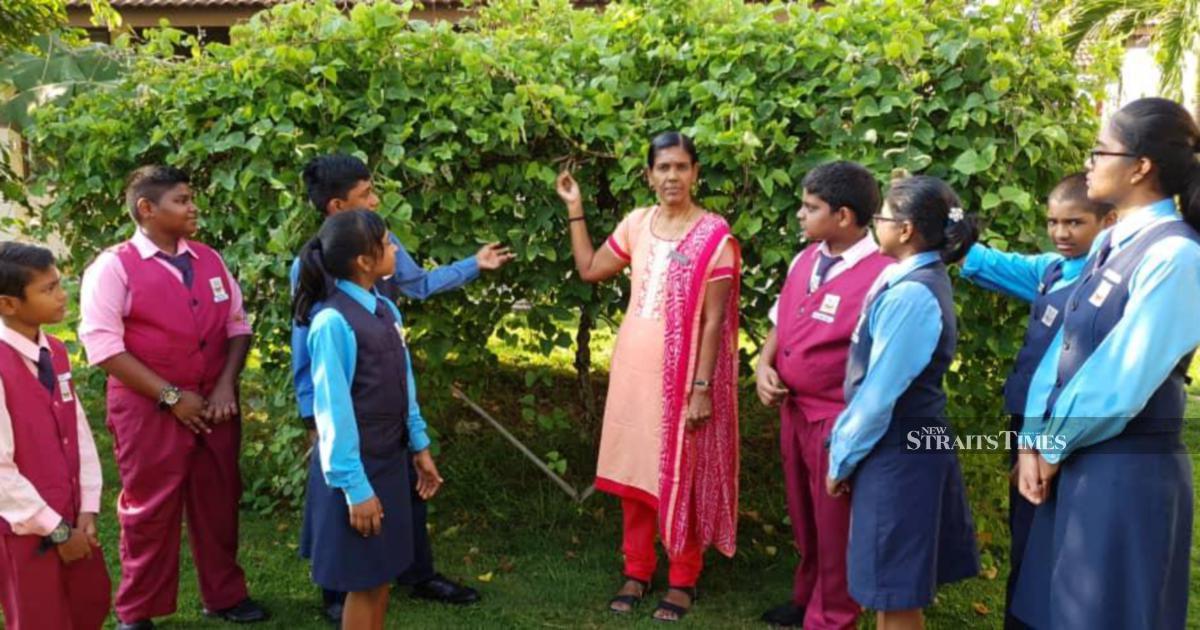
Today, as a Guru Cemerlang Sains at SJKT Kangkar Pulai in Johor, she is known for classrooms that hum with curiosity.
Rejecting rote memorisation, her teaching emphasises inquiry, experimentation and real-world application, encouraging students to question, explore and collaborate – and turning lessons into lived experiences.
“Science is not meant to be memorised,” she says, adding: “It is meant to be lived, questioned and applied. When students see how science solves real problems, learning becomes meaningful.”
Her classroom often resembles a laboratory and workshop combined. Students conduct hands-on experiments, analyse data and discuss solutions to environmental challenges. Confidence replaces fear, and learning becomes a shared journey rather than a rigid syllabus.
Gomathy’s influence extends far beyond her classroom. As head of the school science panel, sustainability coordinator, greenhouse project coordinator and plastic reduction campaign coordinator, she plays a pivotal role in shaping school culture.
Sustainability, under her leadership, is not an extracurricular concept, but an embedded value.
[[nid:1382518]]
Says one of her students: “She teaches us to care for the environment as part of our responsibility. It’s not just about exams — it’s about life.”
Through campaigns on plastic reduction, greenhouse initiatives and green practices, she has instilled environmental consciousness among students and teachers alike.
Among her many contributions, the Hydro Nutri Max TVET Project stands as her flagship achievement. Conceived as a living laboratory, the project integrates STEM education with Technical and Vocational Education and Training (TVET), preparing students for future careers and sustainable living.
SCIENCE OF LIFE
[[nid:1382517]]
Hydro Nutri Max is more than a hydroponic system. It is an ecosystem of learning. Students design and assemble structures, manage nutrient solutions, monitor plant growth and analyse data on water usage and yield.
They troubleshoot engineering challenges, conduct cost analyses and explore entrepreneurial opportunities linked to sustainable farming.
Says Gomathy: “I wanted students to understand that education is connected to life. This project shows them that science, technology and sustainability can create solutions – and even livelihoods.”
[[nid:1382516]]
The impact has been profound. Student engagement has soared; confidence has grown and interest in STEM and TVET pathways has deepened.
The project has garnered recognition at innovation competitions and exhibitions, and is increasingly viewed as a model that can be replicated nationwide.
Gomathy’s journey as an innovator began not with awards, but with empathy. One of her earliest inventions emerged after students observed villagers struggling to access clean water from a river.
Determined to address the issue, she designed a low-cost water filtration model, demonstrating her belief that science education should be socially responsive.
“Science must serve humanity,” says Gomathy, adding softly: “If it cannot solve real problems, then we are not teaching it right.”
Over nearly three decades, she has created more than 80 practical science inventions, impacting over 1,000 students.
Her innovations range from hydroponic and greenhouse systems, to herbal-based products, water purification solutions and sustainability-focused teaching aids.
Many utilise natural, accessible materials, reinforcing affordability and environmental responsibility.
[[nid:1382515]]
In 2018, following personal health challenges, she developed a herbal tonic that was later used as a teaching tool. Based on her tonic recipe, her pupils could learn about chemistry, biology, natural resources and sustainability.
Despite international exposure and accolades, Gomathy’s work is not commercially driven. She often reinvests her own funds into laboratory materials and student projects, a testament to her service-oriented philosophy.
“I don’t see innovation as a business,” she says firmly, adding: “I see it as a responsibility — to give students opportunities I never had.”
Her commitment has taken her work to international platforms across Canada, India, Iran, South Korea, Sri Lanka, Turkey, the United Kingdom, the United States and beyond, earning her numerous national and international awards, including the International Women Achievers Award.
Beyond teaching and innovation, Gomathy is a sought-after resource person, sharing best practices in education at international, national and state levels. Her workshops focus on inquiry-based learning, STEM and TVET integration, educational technology and student mentorship.
What distinguishes her sessions is practicality.
“Teachers don’t need more theory,” she says, adding: “They need strategies that work in real classrooms.”
HONOURS AND RECOGNITIONS
[[nid:1382514]]
Her influence has contributed to capacity-building among educators, fostering a culture of reflective practice and continuous professional growth.
Gomathy’s journey of recognition reads like a quiet crescendo — honours arriving not as ornaments, but as affirmations of a life devoted to shaping minds.
From Johor to the global stage, her work has been repeatedly acknowledged for its depth and sincerity.
Last year, she was named Anugerah Guru Ikon AdiGuru by the state Education Department, a tribute reserved for educators who redefine what it means to teach with purpose, courage and imagination.
In the same year, she received the Anugerah Pesona Wanita Negeri Johor from Yayasan Pembangunan Keluarga Darul Ta’zim, recognising her as a professional woman whose influence extends beyond the classroom into the wider community, inspiring other women to lead with knowledge and compassion.
These national honours sit alongside her recognition as a technology-forward educator — certified by Microsoft and Google — reflecting her ability to weave innovation seamlessly into learning, while lifting fellow teachers along with her.
Internationally, Gomathy’s name has echoed across borders, affirming that her impact transcends geography.
[[nid:1382513]]
She was honoured with global accolades such as the International Excellence in Innovation Award by The International Awards Forum, the International Eminence Excellence Award in India, and the International Women Achievers Award presented by a Canada-based organisation, celebrating her leadership, ethics and social responsibility as an educator of world standing.
In 2023, her lifelong service reached a symbolic pinnacle when she was conferred an Honorary Doctorate (PhD Honoris Causa) in Education by Paris Graduate School, an honour that crowned decades of quiet dedication.
Together, these awards form more than a list of achievements; they tell the story of a woman who turned classrooms into spaces of possibility, whose influence continues to ripple through students, educators and communities, long after the applause has faded.
[[nid:1382512]]
Yet accolades, she insists, are secondary.
“Awards remind me that the work must continue,” she says modestly, adding: “They are not the destination — they are a reminder of responsibility.”
Supported by a family rooted in science and professional excellence, Gomathy now looks ahead to a new chapter — serving as a lecturer in teacher training colleges.
Her vision is clear: to nurture young educators who are innovative, reflective and compassionate.
“If we empower teachers,” she says, “we empower generations.”
As the sun sets over her school, the hydroponic plants continue to grow silently, nourished by water, nutrients and care. Much like her students, they are living symbols of what can flourish when given guidance and belief.
From the quiet rows of hydroponic plants in her Johor classroom to the lives she has touched across communities, Gomathy Sankaran’s story is more than personal achievement.
It is a reminder that from the humblest beginnings can rise educators who, like seeds nurtured with care, grow classrooms into spaces of hope, innovation and possibility — quietly shaping the future of a nation.
© New Straits Times Press (M) Bhd