
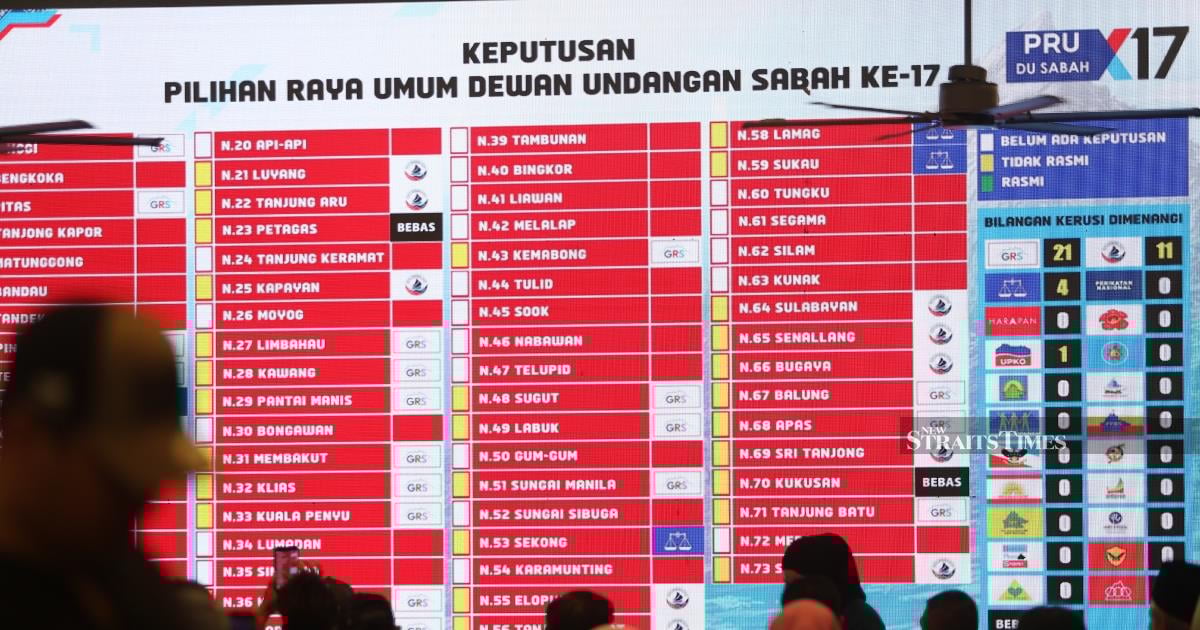
KUALA LUMPUR: DAP must localise its approach and prioritise state-level issues if it hopes to regain footing in Sabah, political analysts say, following the party’s sweeping defeat in the 17th Sabah state election, where it lost all eight seats it contested.
Analysts stressed that simply replicating Pakatan Harapan’s (PH) national narratives in Sabah was insufficient. The party must demonstrate a genuine commitment to local concerns to retain voter trust.
Universiti Malaya socio-political analyst Datuk Professor Dr Awang Azman Awang Pawi said DAP Sabah must “Sabahkan” its identity by embracing an outlook that genuinely understands Sabah’s autonomy agenda, rural development challenges, ethnic sensitivities, and local identity.
He said that the rise of Sabah-based parties had encouraged voters, including former DAP supporters, to experiment with local parties such as Warisan.
“The dominant sentiment in the Sabah election centred heavily on local issues, local interests, local voices, and local identity,” he added.
Azman said that DAP must elevate more Sabah-born leaders, as voters prefer seeing local figures as the face of the party, rather than representatives perceived as “imports” from the Peninsula.
“PH’s strategy failed to counterbalance anti-national party sentiment and frustrations over issues such as water, electricity, and slow development, often associated with federal parties. The wipeout sends a strong message: Sabah voters now demand authentic, locally focused politics, not national rhetoric,” he said.
He said that DAP would need to engage more actively at the grassroots level, visiting villages and small towns and addressing practical issues such as water supply, electricity, roads, and welfare, rather than focusing primarily on ideological debates online.
Azman also suggested that DAP consider strategic cooperation with local parties.
“Long-term strategies could include electoral arrangements or partnerships with Warisan, the United Progressive Kinabalu Organisation (Upko), or segments of Gabungan Rakyat Sabah (GRS). DAP must acknowledge its weaknesses and present a clear reform plan to voters; transparency will help restore its image as a party willing to change,” he said.
He added that voters were increasingly confident in Sabah-based parties that champion state autonomy, stronger state powers, and identity-based politics.
“Many high-profile DAP candidates, including former MPs and state assemblymen, were defeated. This shows that past reputation is no longer enough; voters assess who truly acts locally and who can align state interests with national politics,” he said.
Echoing Azman, International Islamic University Malaysia Associate Professor of Political Science Dr Syaza Shukri said DAP’s votes largely shifted to Warisan, seen as vocal on Sabah issues.
“DAP must collaborate with grassroots partners and NGOs to rebuild trust. The party is perceived as an outsider, but the main issue is that it is punished as part of PH amid voter dissatisfaction both nationally and locally. Urban Chinese voters are more issue-oriented, so it is not surprising they are ‘punishing’ PH and DAP. If DAP wants to retain influence and credibility in Sabah, it must show it is serious about local issues,” she said.
Syaza added that with PKR winning only a single seat, the entire PH coalition must rebuild its image, having lost the reformist appeal it once held in government.
In the election yesterday, Gabungan Rakyat Sabah won 29 of the 55 seats it contested. Parti Warisan secured 25 seats, followed by Barisan Nasional with six. Independent candidates won five seats, United Progressive Kinabalu Organisation three, Star Sabah two, while Perikatan Nasional, Parti Kesejahteraan Demokratik Masyarakat and Pakatan Harapan claimed one seat each.
A total of 1,148,476 voters cast their ballots, representing a 64.35 per cent turnout.
© New Straits Times Press (M) Bhd