
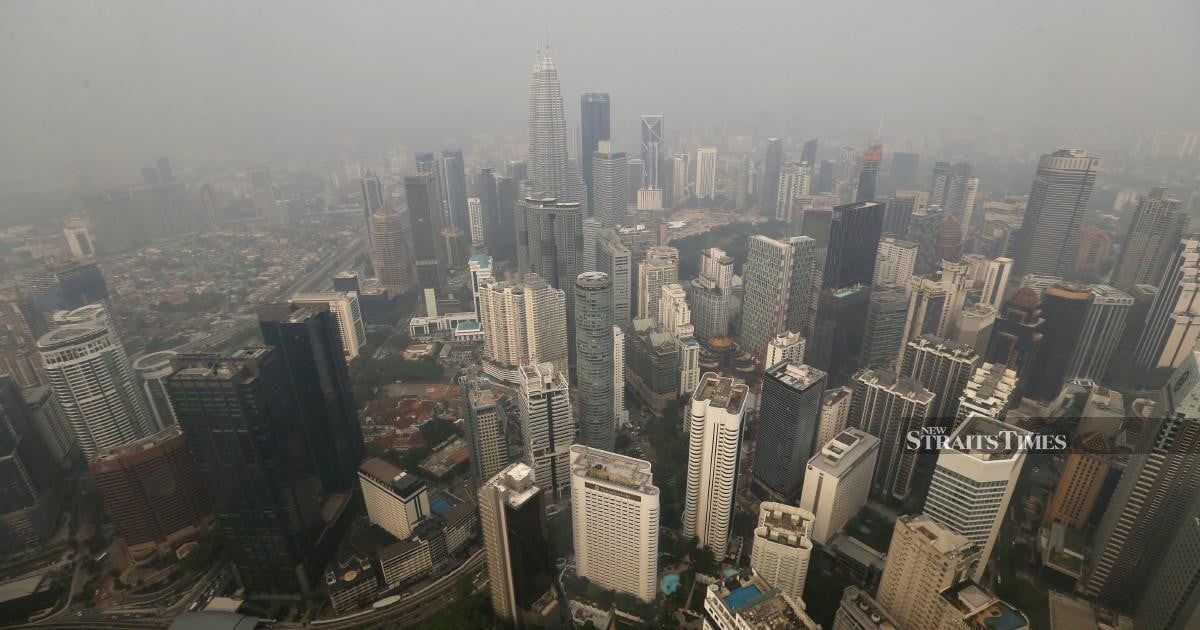
IN Malaysia, people usually notice air pollution only when haze covers the skyline. But even before the air looks grey, millions of city residents are already breathing in pollution that slowly harms their health.
A look at Particulate Matter 2.5 (PM2.5) levels in Greater Kuala Lumpur from 2018 to 2023 shows that unhealthy air is not just a problem during haze events. Instead, people are exposed to it on most days throughout the year.
PM2.5 is made up of tiny particles that can reach deep into the lungs and even enter the bloodstream. Breathing this air for a long time is linked to heart disease, lung problems, and early death.
The World Health Organisation (WHO) has acknowledged the significant impact of PM2.5 towards human health.
Six years of data from eight air quality stations in places like Bangi, Batu Muda, Cheras, Klang, Kuala Selangor, Putrajaya, Petaling Jaya, and Shah Alam show a clear pattern in PM2.5 levels across Greater Kuala Lumpur.
Even though these areas differ in how they are used and how busy they are, all showed similar long-term trends. This means PM2.5 pollution is a problem for the whole region, not just certain spots.
2019 had the highest PM2.5 levels in Greater Kuala Lumpur. September that year was especially bad, with 80 to 100 per cent of days going over both Malaysian Air Quality
Standards (MAQS-35 microgrammes per cubic metre) and World Health Organisation (WHO- 15 microgrammes per cubic metre) daily guidelines. This shows people were exposed to unhealthy air for a long time during the haze from other countries.
From 2020 to 2022, air quality improved as average PM2.5 levels dropped a lot. With less traffic, industry, and movement during Covid-19, the air got cleaner. This shows that cutting emissions can really lower PM2.5 in cities.
But in 2023, PM2.5 levels started to rise again at all stations. Although they did not reach 2019 highs, this increase shows that earlier improvements did not last.
The key point is not just the extreme years, but what happens in the years between.
Between 2018 and 2023, “medium pollution” levels daily PM2.5 concentrations of 15 to 35 microgrammes per cubic metre occurred on half to three-quarters of days each year in Greater Kuala Lumpur.
This means many residents were exposed to air above WHO health guidelines for 180 to 270 days annually, often without public alerts or any change in routine. For most people, this means they are exposed to PM2.5 all the time, not just occasionally.
Even if single days do not seem worrying, being exposed to these levels for years raises the risk of heart disease, carcinogenic diseases, asthma, and shorter life expectancy.
Importantly, it reveals that days that meet Malaysia’s current standards are not always safe according to international health guidelines. This shows there is a gap between following the rules and protecting health.
PM2.5 levels also change in regular daily and seasonal patterns. In Greater Kuala Lumpur, PM2.5 levels are highest in the early morning and at night, when cooler air keeps pollution close to the ground.
This happens at the same time as commuting and ongoing city emissions, so people are exposed most when they are active.
PM2.5 levels are also highest during the Southwest Monsoon, from June to September. This is when the weather is drier and there is more burning of plants, making it easier for both local and foreign pollution to build up over cities.
These regular patterns mean that higher exposure can be predicted, not just seen as random. This gives a chance to prepare better for public health and to target solutions.
People often see air pollution as just an environmental problem, but its effects go much further. While polluted air is harmful to everyone, its impacts are not evenly shared.
Children, older adults, pregnant women, individuals with asthma or chronic heart and lung disease, and those with prolonged outdoor exposure are far more likely to suffer severe health consequences.
Over time, sustained exposure to PM2.5 places growing pressure on the healthcare system, reduces worker productivity, and generates high economic costs even in the absence of a major haze crisis.
The better air quality observed from 2020 to 2022 shows that cleaner air is possible, but it requires ongoing, planned efforts.
Malaysia has usually managed air quality by reacting to severe haze emergencies. But data from 2018 to 2023 shows that this is no longer enough.
Increasingly, people call air pollution an “invisible epidemic” in fast-growing countries. As The Hindu, an Indian newspaper, recently said about India, the real danger is not just in big pollution events, but in getting used to constant exposure.
Data from Greater Kuala Lumpur suggests Malaysia could be going the same way, with moderate pollution becoming normal and its health effects quietly adding up.
If Greater Kuala Lumpur is to reduce its true air pollution burden, policy attention must shift towards:
1. Lowering everyday urban emissions from traffic and industry;
2. Integrating air quality considerations into urban planning and transport policy;
3. Strengthening regional cooperation to address seasonal transboundary pollution; and
4. Investing in data-driven air quality management, including big data analytics and wider deployment of low-cost sensors, to support timely and spatially detailed policy responses.
Air pollution can harm people even when it cannot be seen. For millions in the Klang Valley, this burden is already being breathed in every day.
The data is clear. Now the question is whether clean air will be seen as just a short-term fix during crises, or as something valuable that should always be protected.
*The writer is a PhD graduate in Chemistry (Atmospheric Science) from the University of Cambridge. The article draws on scientific findings from his doctoral thesis titled ‘Assessing PM2.5 pollution and the role of transboundary emissions across Greater Kuala Lumpur, Malaysia (2018-23)
© New Straits Times Press (M) Bhd