
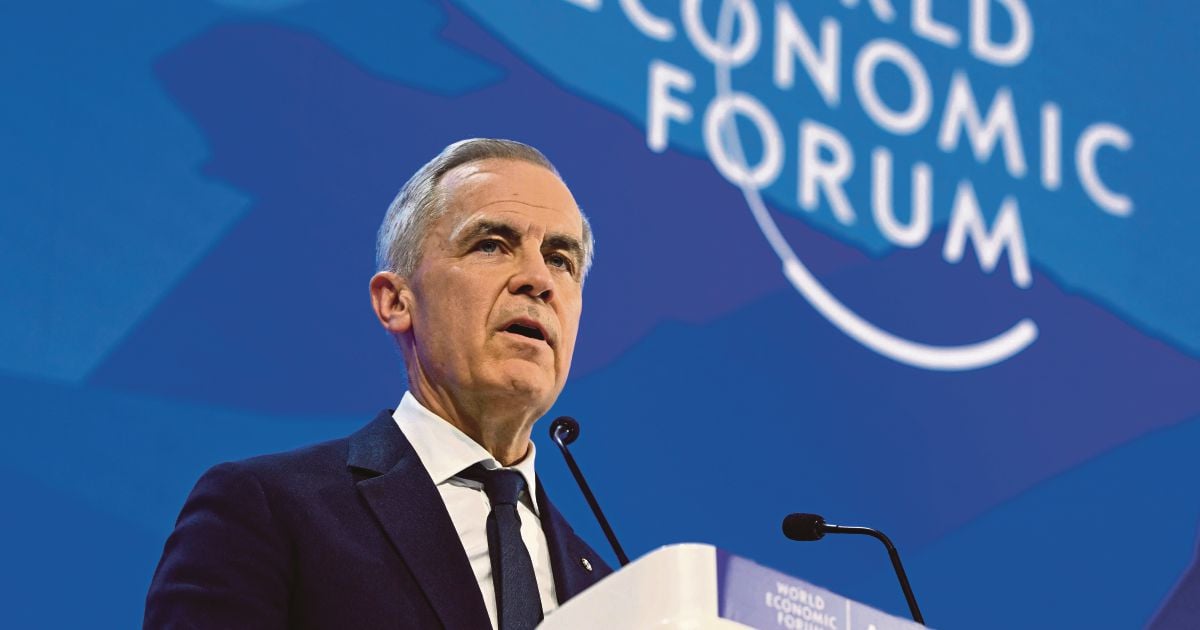
JUDGING by the number of friends who shared with me Canadian Prime Minister Mark Carney’s speech at the Davos World Economic Forum, he must have struck quite a chord even in these parts.
The speech was reported to be greeted by a standing ovation. Why did it resonate with so many?
In it, Carney lamented the end of the “rules-based” world order.
This world order was not overturned by an upstart power but, apparently, by the very hegemon that birthed and sustained it since the end of the last world war.
Since the return of President Donald Trump, Canada — America’s closest neighbour and friend, and not just because of geographical proximity — has borne the brunt of Trump‘s taunts, threats and, of course, tariffs.
Like most nations, Canada’s initial instinct was to accommodate Trump.
“Canadians know that our old comfortable assumptions — that our geography and alliance memberships automatically conferred prosperity and security. That assumption is no longer valid,” noted Carney.
But Carney was not using his address in Davos to lament in despair.
When global hegemons turn into bullies and predators, there are options for “middle powers” like Canada, such as by weening off dependence on trade with its giant southern neighbour.
These include forging free trade arrangements around the world, including with Asean countries.
Realistically, a highly fragmented world means one in which each country or group of countries looks out for its interests.
But that does not mean that these countries cannot or will not look out for enlightened self-interests and cooperate in the belief that the sum will be greater than its parts.
Malaysia must also seek out such “like-minded” countries like Canada to safeguard our independence and freedom.
Why do I call Canada “like-minded”?
We are, after all, both former British colonies, still members of the Commonwealth and politically organise ourselves as federal democracies. We grant autonomy to states.
Moreover, Malaysia and Canada can and should draw strength and comfort from the many parallels of our multicultural societies.
Even as we faced the May 13, 1969 tragedy, Canada likewise faced near-existential threats in the 1970s as separatist sentiments in French-speaking Quebec briefly turned violent.
Such affinity ought to be highlighted to establish bonds that bridge the distance between both countries.
Further, Malaysia and Canada can also identify with each other as countries living under the shadow of a giant neighbour — an ascendant China in our case and the US in Canada’s.
Both countries presumably want the same thing here: the freedom to be friends with both powers and not be drawn into picking one over the other.
The writer views developments in the nation, region and the wider world from his vantage point in Kuching
© New Straits Times Press (M) Bhd