PUTRAJAYA: Malaysia must take decisive action to ensure that reforms under the Madani framework are genuinely rooted in justice, integrity and moral conviction, emphasising that progress cannot rely on routine approaches alone but requires addressing deep-seated systemic failures.
Prime Minister Datuk Seri Anwar Ibrahim said policies that sound lofty in rhetoric but are hypocritical in practice inevitably contradict the very ideals of justice, honour and liberty they claim to uphold. Genuine reform, he added, must be grounded in conviction, courage and consistency.
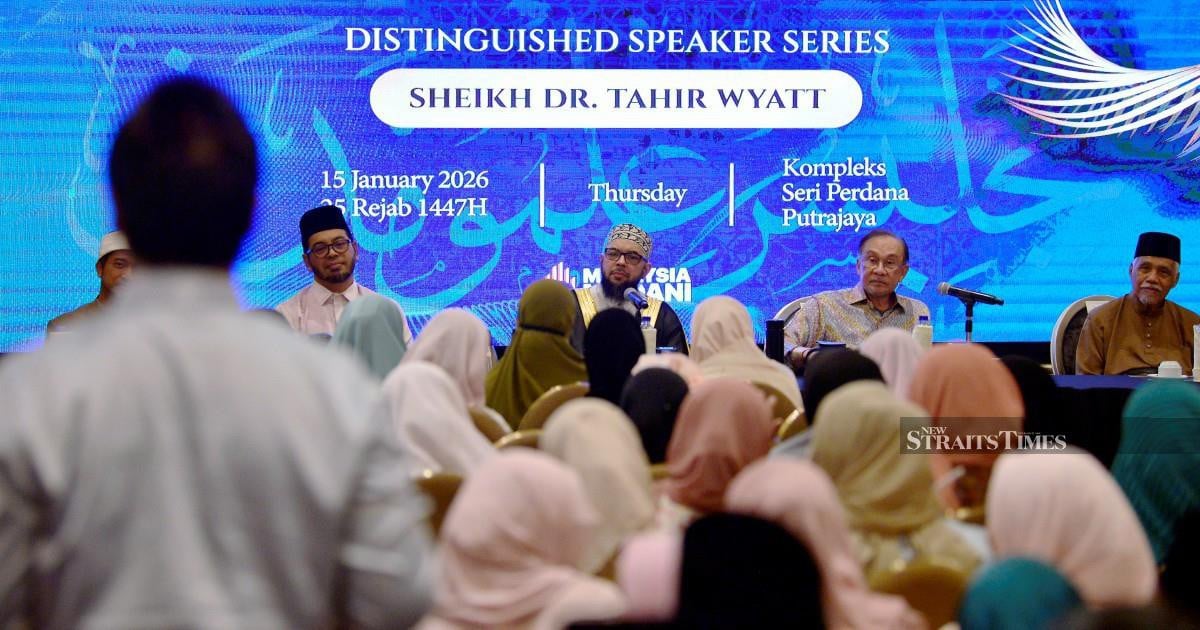
Speaking at the Madani Lecture here today, Anwar said being truly “rooted” or mengakar ke bumi requires going beyond routine procedures. While existing systems are not total failures, many underlying causes of injustice and corruption have been identified and must now be addressed decisively.
Anwar said Malaysia’s reform agenda under the Madani framework places strong emphasis on governance and the eradication of systemic corruption inherited from the past, noting the country’s international association with the 1MDB financial scandal.
He highlighted recent enforcement actions, including the unprecedented move to charge the head of the armed forces, as reflecting the government’s courage of conviction and determination to uphold accountability, despite political and institutional challenges.
“No country, however wealthy, can remain strong or improve education, public health and infrastructure if billions are lost through corruption,” he said, stressing that good governance must be accompanied by balance, including moral and ethical considerations, to ensure sustainable national development.
On the economic front, Anwar said Malaysia is positioning itself as an emerging hub for investment, particularly in new technologies such as artificial intelligence, digitalisation and energy transition, while strengthening regional connectivity through major infrastructure initiatives, including cross-border and undersea cable projects linking Peninsular Malaysia with Sabah and Sarawak.
However, he cautioned that economic progress and technological advancement must not come at the expense of identity and values. The country, he said, is neither exclusively aligned with the East nor the West and must preserve its cultural, spiritual and moral foundations.
Anwar said the philosophy of ‘menggapai langit, mengakar di bumi’ should guide national development, particularly in education, where the pursuit of new knowledge, technology and innovation must be firmly rooted in tradition, aqidah, akhlaq and enduring values.
He added that the government has introduced a new higher education plan aimed at integrating knowledge acquisition with truth, righteousness and wisdom, stressing that academic excellence devoid of values would result in contradictions and moral failure.
The prime minister also highlighted the responsibility of the younger generation to take education seriously, saying excellence in learning is an obligation not only to oneself and one’s family, but also to society, the nation and the ummah.
“Islam encourages continuous learning, humility and critical thinking, and cannot be reduced to superficial understanding or limited exposure,” he said.
Meanwhile, the Madani Lecture featured distinguished speaker Sheikh Dr Tahir Wyatt, whose engagement with the youth, Anwar said, reflected the importance of deep scholarship, wisdom and ethical grounding in addressing contemporary challenges.
During his 30-minute talk, Sheikh Tahir emphasised that true success, as defined by Islam, is not measured by worldly achievements but by complete submission to Allah.
He said the Quran’s command to “not die except as Muslims” is in fact a call to live in a constant state of submission to Allah, noting that submission is especially difficult for those with strong egos.
“People often resist truth not due to a lack of evidence, but because pride prevents them from surrendering. However, with iman, submission becomes a source of peace,” he said, adding that beyond individual responsibility, the ummah carries a collective duty to remain united.
Sheikh Tahir is a senior researcher and lecturer in Islamic studies and comparative religion. He embraced Islam at the age of 15.
© New Straits Times Press (M) Bhd