
I am from London. Nothing there could have prepared me for watching the World Cup in Kuala Lumpur.
Back home, football means one thing — a pub. Here, the street itself becomes the venue. Three venues in, and I am already convinced that doing this properly is going to require a lot more teh tarik and far less sleep.
My first stop was NZ Curry House on Jalan Ampang, the one sitting in the shadow of the Petronas Twin Towers, open 24 hours, as Malaysian as it gets.
Czechia was playing South Africa, a Group A clash that ended 1-1. Not exactly a headline fixture. And the crowd reflected that.
It was quiet. Sparse, even. A handful of us, scattered across the tables, were watching a match that most of the world had probably skipped in favour of sleep.
Nonetheless the atmosphere, or lack of it, was strangely its own kind of experience. Just me, a teh tarik, a small screen, and a genuinely tense late equaliser.
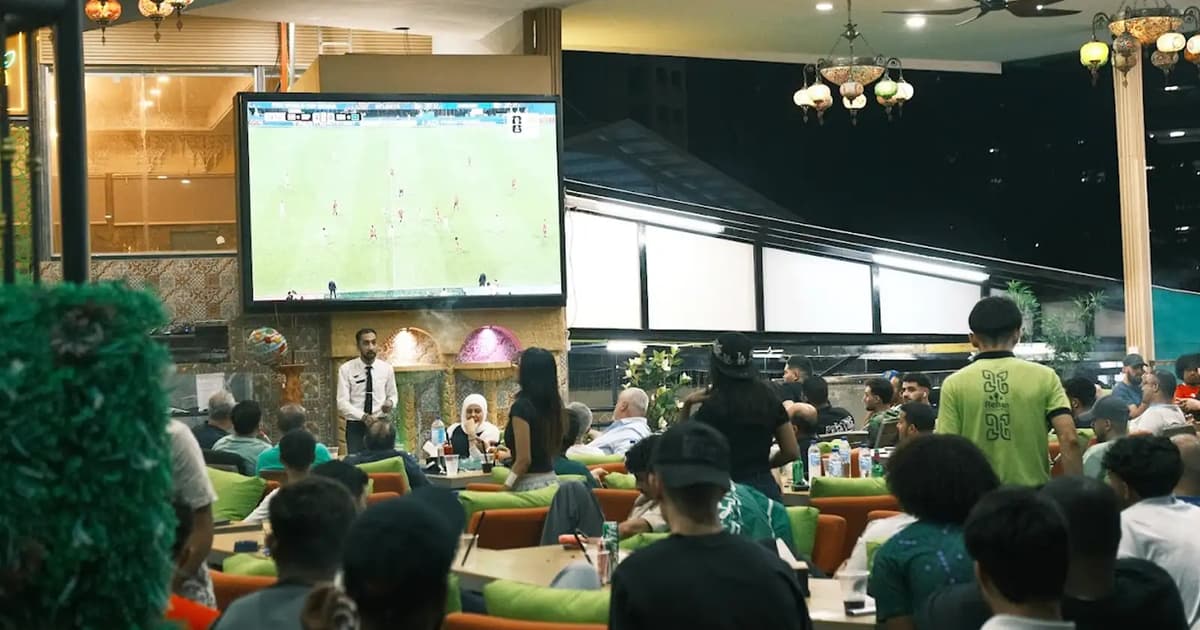
The second game was a different world entirely. I went to Rehan Restaurant for Spain vs Saudi Arabia, and the moment I walked in, I knew this was not going to be a quiet night.
Spain won 4-0, with a stunning three-goal blitz inside the first half-hour. Teenage sensation Lamine Yamal scored his first World Cup goal inside 10 minutes, followed by two more from Mikel Oyarzabal.
But honestly, the scoreline was almost secondary to what was happening in that room. The Saudi fans had come out in full.
It was loud, it was passionate, and for those first 10 minutes before Spain started dismantling them, there was genuine hope in the air. That is something you simply cannot replicate watching from your sofa.
Which brings me to the wider point I keep coming back to: KL does this better than most cities I can think of.
One night I found myself walking through Changkat Bukit Bintang, and the street itself had become a spectacle. A melting pot of food, culture and cheer.
It was Wednesday, June 17; that night, Argentina were on the screens. Every corner, every step, a different jersey. Brazil. Portugal. Argentina. France.
Flags I recognised and some I had to look twice at. Nationalities from every corner of the world, all ending up on the same street in Kuala Lumpur on the same night, wearing their colours but absolutely nothing else in common.
That is what struck me. Everyone had the same look, but no two people were the same. Outside restaurants, inside cafes, spilling onto the pavement.
And because Argentina was playing that night, the debates had already started, its traditional rivalry with Portugal, the eternal argument, playing out between strangers who had never met and probably never will again.
I never joined in. I just watched. But that is its own kind of experience, being in the middle of a beautiful mess of cultures clashing over football in a city that does not need to try to be diverse; it just is.
While the English have their pubs, Australians have their clubs, and Americans have their sports bars, Malaysians have mamaks that are genuinely unbeatable.
Open 24 hours, cheap food, cold drinks, loud opinions, and football on a big screen. No subscription needed. No reservation required.
The time zone means many matches kick off in the early hours of the morning or during breakfast hours in Malaysia, and a mamak is simply the only place that makes waking up at 3am feel like a reasonable life choice without breaking the bank.
But what has genuinely surprised me this tournament is how much further the options stretch beyond the mamak.
KL has venues, showing the same games to a completely different crowd. Outdoor cinema cafes, Latin-themed restaurants with special match-night menus, rooftop spots with large screens.
The city basically has a venue for every version of the World Cup experience you want, from rowdy to relaxed, from teh tarik to Arabic tea to a Guinness.
Three areas of KL. Plenty of tournament matches left. And already I have seen things here that London simply could not give me.
The writer, an undergraduate at Queen Mary University of London, is currently serving his internship at FMT.
The views expressed are those of the writer and do not necessarily reflect those of FMT.