
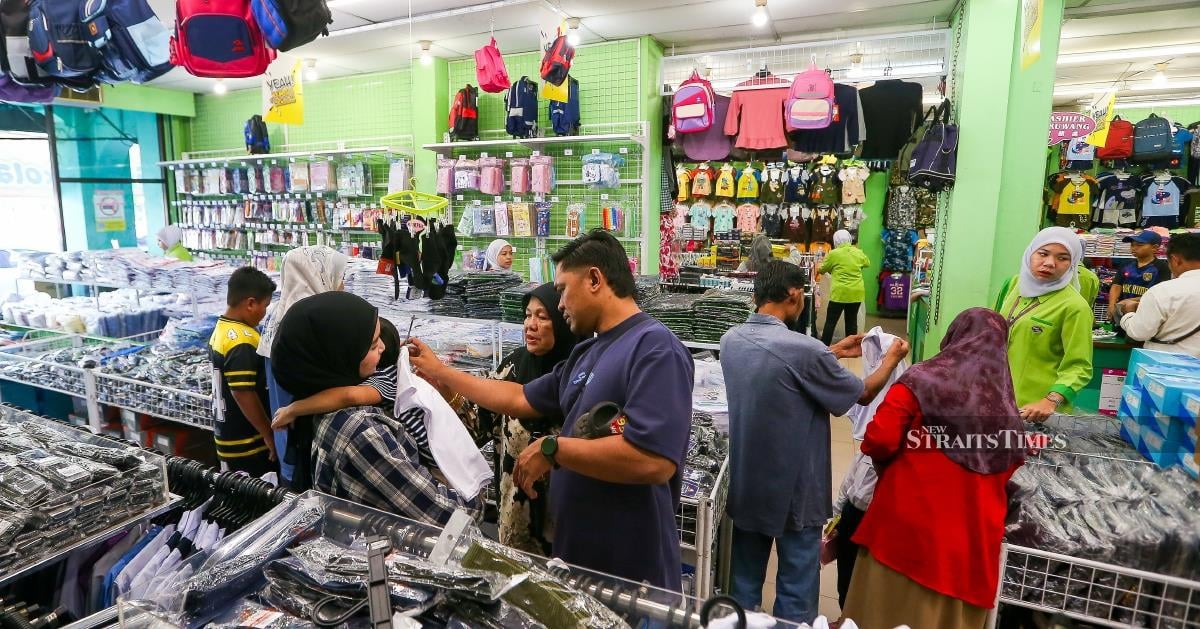
KUALA LUMPUR: RM150 may seem modest in the face of today’s rising cost of living, yet for Hafizah Alli, who lives at the foothills of Mount Santubong in Sarawak, the Early Schooling Assistance (Bantuan Awal Persekolahan – BAP) is a lifeline — small in value, but deeply meaningful.
A mother of three school-going children, Hafizah is often gripped by worry at the start of each new school term. As her children grow, school uniforms that no longer fit must be replaced, adding to the financial strain.
On top of that, a list of fees to be paid further tightens the family’s finances, especially as her husband works only as an administrative assistant at a government department — earning just enough to get by — while she is a full-time homemaker.
“When the school season begins, we really have to think carefully about many things. Not just books or uniforms, but fees, food, and other needs too. With assistance like this, we feel truly grateful — not because the amount is big, but because it helps lighten the burden,” she shared when contacted by Bernama recently.
VALUE OF RM150
This year, the Madani government has allocated RM800 million for BAP, benefitting 5.2 million schoolstudents, from Year One to Form Six.
The RM150 per student assistance has been distributed directly through school teachers beginning Jan 11, aimed at ensuring students’ educational needs are met.
Hafizah, 39, said that with school supplies becoming more expensive, she and her husband carefully plan how to use the BAP so that every ringgit spent delivers maximum value.
“Here, school trousers used to cost about RM40 per pair (depending on size), but now they’re nearly RM50. So we really have to buy according to what’s necessary.
“But we’ve trained our children, especially the youngest, Nur Ayesha Armani, who is only 10. We tell her — if the school bag is still in good condition, we postpone buying a new one. For uniforms, we buy one essential set first. If there’s extra money, only then do we buy a second set,” she added.
To stretch the assistance further, Hafizah chooses to travel to Kuching, about 45 minutes from her home, to purchase school necessities for her children.
“There are grocery shops here, but if we go to the city, we can buy a complete set of school supplies all at once, and it’s actually cheaper. Luckily, my husband works in Kuching, so he knows the place well and which shops sell at prices we can afford,” she said, adding that the full RM150 assistance is used entirely for her children’s schooling needs.
BAP not only provides relief for parents in rural areas. Many urban families feel the strain each time a new school session begins, including Siti Wardah, a public sector employee.
“I live in Kuala Lumpur and have four children — two in primary school and two in secondary school. When school season comes, it’s really stressful,” she shared, adding that BAP helps ease the load, especially for the purchase of books, equipment and basic clothing.
While grateful for the initiative, some parents expressed hope that the assistance could be distributed earlier.
“Right now, BAP is given when school is about to reopen, so parents have to spend out of their own pockets first. It’s not that we’re ungrateful, but we would be even more thankful if the BAP could be given earlier,” they said.
A SOCIAL AND EDUCATIONAL INSTRUMENT
Whether in rural or urban areas, BAP provides meaningful support to parents, especially those with several school-going children, regardless of whether they come from the M40 or B40 groups.
Commenting on the assistance, social expert and Universiti Putra Malaysia Faculty of Human Ecology Dean, Prof Dr Mohamad Fazli Sabri, said financial aid is not merely about money, but also about the social impact it creates.
“The amount may seem small to some, but the social impact is significant. Assistance like this can prevent parents from falling into debt or being deceived by scams promising quick income.
“BAP helps everyone, regardless of group, because students’ needs today are increasing,” he said.
More importantly, he said, parents need to spend wisely and avoid being swept up by popular trends.
“In short, there’s no need for expensive items because this money (BAP) is meant for the development of human capital,” he added.
At the same time, Mohamad Fazli highlighted another positive effect stemming from the distribution of BAP through schools.
“To receive the BAP, parents need to go to their child’s school. Some parents are rarely involved in school activities, so indirectly BAP creates interaction between the school and parents,” he explained, also suggesting that schools monitor the usage of BAP to prevent misuse.
“Maybe it can be recorded what the BAP is spent on,” he added.
AN ECONOMIC BOOST AND HUMAN CAPITAL DEVELOPMENT
Senior lecturer at the Universiti Sains Islam Malaysia’s Faculty of Economics and Muamalat, Dr Muhammad Iqmal Hisham Kamaruddin, sees BAP not just as support for parents, but also as a small-scale economic stimulus, as about 80 per cent of the RM150 is typically spent on school needs, including bags, stationery and books.
“At the beginning of every year, parents rush to buy their children’s basic school necessities. Based on research, almost the entire amount is used for that purpose, so it eases the household burden and allows families to focus on other spending,” he explained.
To measure BAP’s effectiveness, the economist suggested tracking early-year domestic spending indicators. According to him, spending usually increases during this period, much like during festive seasons.
From a macroeconomic perspective, he said the RM800 million allocation would directly impact the domestic economy.
This approach, he explained, injects cash flow into sectors such as clothing, books, printing and retail outlets, while also triggering a ripple effect as people go out to shop — stimulating local spending cycles.
“From a broader perspective, this spending cycle benefits many entrepreneurs and businesses in both urban and rural areas,” he added.
While it may be smaller in scale compared with other government economic stimulus measures, such cash injections are still capable of mobilising the local economy and, indirectly, help build the human capital of the future, he added.
Supporting the view, the Malay Hawkers and Small Traders Association of the Federal Territory president Datuk Mohamad Abdullah said the spending generated through BAP has contributed to greater vibrancy in the local economic cycle.
“We can see that BAP is being spent at local shops and stalls, most of which rely on daily income,” he said.
CONTINUING TO MAKE A POSITIVE IMPACT
Commenting on the assistance amount, Muhammad Iqmal Hisham said that from a broader economic standpoint, RM150 per student may not be sufficient, given the rising cost of schooling necessities in recent years.
“The value may not cover the full cost, but it still reduces the burden on parents and remains relevant amid today’s cost of living,” he said, adding that BAP serves as a short-term “investment” to help children begin the school year more comfortably.
Noting that BAP also carries an implicit message, he said ensuring children can learn well in school requires not only financial support, but also social motivation.
“Through assistance like this, children can be trained to appreciate resources, build financial discipline, and eventually become a future generation that is educated, independent, and able to contribute to society.
“Financial aid, though it may appear small in nominal terms, can still have a big impact on families and communities. It not only eases today’s burden but also builds the foundation for children’s future,” he added.
© New Straits Times Press (M) Bhd