
“THERE’S someone on the ledge! She’s going to jump!”
Captain Balasupramaniam Krishnan was in the middle of a talk when a security guard came running, breathless. Outside a high-rise window, a woman was perched precariously, clinging to a rope made from knotted clothes. Her name was Ceriyati Dapin, an Indonesian domestic worker — beaten, starved and desperate enough to risk everything.
It was June 2007. Ceriyati had tried to escape through the window of her employer’s 18th-floor apartment, tearing her clothes into strips and knotting them into a makeshift rope. It failed. She ended up stranded on a narrow ledge on the 15th floor, suspended between terror and hope.
Recalling the moment, Bala shares a piece of advice he never forgets. “When someone wants to jump, you don’t shout from below. They can’t hear you.”
So he went one floor above her.
He secured a rope — only 3.66 metres long — told his team to support him and climbed down. The rope barely reached. One wrong move and there would have been no margin for error.
She looked up at him with swollen, tear-filled eyes, her hands shaking. “Saya tak mahu mati! (I don’t want to die!)” she sobbed.
Trying to steady her — and himself — Bala cracked a joke, even as his own life hung in the balance. “Me too,” he admitted. “I’m in the middle of a training. I also don’t want to die today!”
When he reached her and lifted her into his arms, the reality struck him. She weighed barely 30 kilos. “I could feel how light she was,” he recalls. “Clearly, she had been abused.”
Slowly, carefully, he brought her back from the edge.
[[nid:1354346]]
What Ceriyati wanted was simple. “I want to go home,” she told him. “I want to see my daughter. I don’t want to die here.”
The rescue made headlines. The public saw the dramatic images — a burly Indian man emerging from nowhere, hauling a slight, broken woman to safety. What no one saw was where Bala’s rope was tied. Not to a beam. Not to a railing. But to one of his own men — “my boy”, as he calls him — whose life was hanging in the balance too.
On August 17, 2007, Indonesia’s National Day, Bala was formally recognised by then Indonesian ambassador to Malaysia A.M. Fachir in Kuala Lumpur for protecting one of the country’s citizens in Malaysia.
Bala declined the personal recognition. “Give it to my boy,” he insisted. “He’s the one who had the rope tied around him.”
Ceriyati Dapin went on to rebuild her life in Indonesia. Today, she speaks up for women and migrant workers, her experience often cited as a reminder of the risks faced by domestic workers and the need for stronger protections.
That the woman he once rescued has since found her voice matters deeply to him.
Leaning back in his chair at the Code Red Survival Academy in Cheras, the genial 51-year-old says, matter-of-factly: “When terrible things happen, don’t forget this. God is still at work. Even in the darkest moments… He is already planning something good.”
Pithy advice, indeed. Bala draws easily from decades of rescues and close calls, experience that has given him both wisdom and a distinctly worldly edge.
[[nid:1354345]]
Much has been said about the broad-built man. Bala is best known not for titles, but for showing up when things go wrong. A safety activist, emergency trainer and humanitarian by instinct rather than label, he has spent decades teaching ordinary Malaysians how to stay alive, respond under pressure and help others do the same.
Along the way, he founded the Malaysia International Search and Rescue (MISAR) and the Code Red Survival Academy, driven by a simple belief: Preparation saves lives.
LESSER-KNOWN VOCATION
[[nid:1354344]]
On this sunny afternoon, he turns out to be an excellent host too. There are chocolates, vitamin drinks and a wide grin as he urges, “Please help yourself lah!” Chocolates and conversation? Hard to say no.
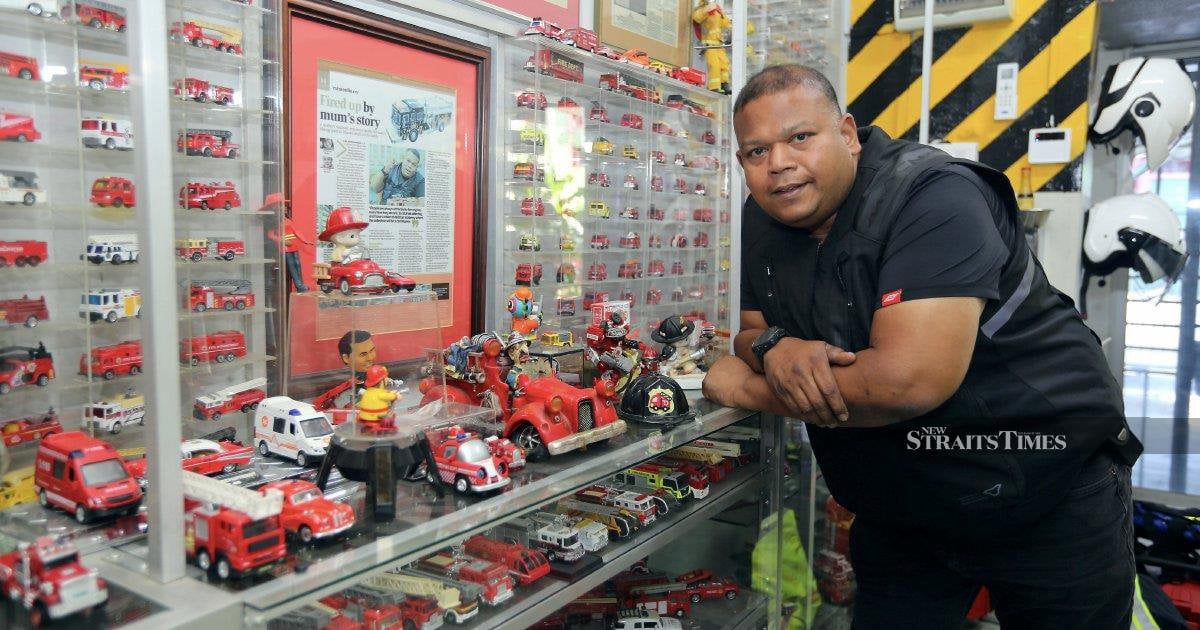
Around the office, the walls and cabinets are crowded with newspaper clippings, medals, certificates and photographs of Bala receiving awards. There is also an impressive collection of miniature fire trucks — a reminder of the boy who once dreamt of becoming a firefighter, and never quite let that go. As the tour continues, it becomes clear that while the walls tell one story, there is far more to Bala than what has been documented, framed and filed away.
“If you ask me what my primary business is,” he says, settling back into his chair, “it’s crime. Crime is my business.”
That is not what I expected.
Seeing my raised eyebrows, Bala continues almost offhandedly. “I do crime intervention. I look for missing people. I reopen cases that others have closed.”
From tracking down runaway teenagers to investigating theft and misappropriation of funds, there is little he will not take on — for a fee.
“This is what I do professionally,” he explains. “And when you work in this space, there is always risk.”
Some of the stories are unsettling. He recounts tracing a runaway girl all the way to Ijok, where she had disappeared into a remote settlement. After days of searching, he found her hiding in a dilapidated hut. She was rescued, but not before Bala spent hours persuading her to return home to a distraught mother.
[[nid:1354343]]
“When you make crime your business, you make enemies,” he admits. It is a line of work few are willing to venture into. His work extends beyond investigation into prevention, which is why he also conducts self-defence training and safety briefings, particularly for women.
His eyes sweep to my handbag beside me. “I’ve got a device I designed to stop your handbag from being snatched while you’re driving,” he says. “I’ll give it to you later.”
It is such a Bala moment. Practical. Thoughtful. Always thinking a step ahead.
[[nid:1354342]]
Search and rescue, however, sits in a category of its own. That work, he is clear, is entirely voluntary.
“Search and rescue is what I do to serve,” he says. Crime intervention is professional work, governed by different boundaries and responsibilities.
EARLY PASSIONS
[[nid:1354341]]
Born in Melaka and raised in Kuala Lumpur, Bala grew up in a household shaped by discipline and enterprise. His late father served in the police force, while his mother also ran small businesses. The youngest of three siblings and the only son, he learned early to stand on his own feet.
By the age of 10, he was delivering newspapers before dawn, earning RM1 a day, before heading to school. During school holidays, he worked at grocery shops and earned extra cash watching helmets at the stadium. “I wasn’t poor,” he says. “I had my own money. I even bought my own bicycle.”
That same independent spirit would later shape his approach to rescue work. He learnt on the ground, then chose to build something of his own. Barely out of school, he founded MISAR in 1991 to respond quickly and independently when emergencies struck.
“Back then, things were different,” he recalls. “It was easier to approach the Fire and Rescue Department, speak to senior officers, get onto training programmes and learn.”
MISAR began with simple civic work, including cleaning and maintaining fire hydrants. Under programmes such as Skim Teman Pili Bomba, volunteers helped monitor hydrants, prevent vandalism and keep them emergency-ready — a reminder that effective response starts long before disaster strikes.
During one such clean-up, a passer-by stopped to watch. He turned out to be the deputy director of the Fire and Rescue Department. Doors opened. Before long, MISAR was assisting alongside the department.
Not long after its founding, his organisation had the opportunity to prove its mettle in the Bright Sparklers fireworks factory disaster in Sungai Buloh on May 7, 1991. The explosion killed 26 people, injured more than 100 others and destroyed dozens of homes.
“When we arrived, it looked like a war zone,” Bala recalls.
[[nid:1354340]]
At the time, the team could only help after work. Night after night, they turned up anyway. It was exhausting, unpaid and often unseen — but Bala knew then that this was the path he wanted to follow.
MISAR would go on to do far bigger things. Over the years, the team responded to defining tragedies, beginning with the 1993 Highland Towers collapse and, in 2003, its first international mission to Bam, a city in southeastern Iran, following a devastating earthquake.
[[nid:1354339]]
Since then, MISAR has taken part in more than 10 international search-and-rescue missions, including the 2004 Asian tsunami in Aceh, the 2008 Sichuan earthquake in China and the 2015 Nepal earthquake.
UNEXPECTED DANGER
[[nid:1354338]]
Things were looking bright for Bala. Alongside his volunteer rescue work, he began taking on crime-related cases, deliberately expanding his skill set. He studied behavioural science to better understand human behaviour, believing insight was as critical as physical response. Both strands of work were gaining momentum. Then, in 1994, everything changed.
Bala had earlier intervened in a domestic violence case, helping the victim escape, relocate to safety and lodge police reports. In doing so, he angered the abusive husband.
“I always forget,” he reflects now, “that I left a ticking time bomb.”
Not long after, while riding his motorcycle near a toll plaza in Cheras, Bala was targeted. A vehicle rammed into him from behind.
“I saw them reverse,” he recalls. “And when they came at me again, I knew it was deliberate.”
The impact shattered his body. His legs were twisted and badly broken, ligaments torn. Barely clinging to life, Bala was rushed to hospital — the survivor of a targeted attack that would alter the course of his life.
Recovery was slow. While still in hospital, Bala made a vow: if he ever walked again, he would donate wheelchairs to the hospital. It is a promise he continues to keep, quietly and consistently, years on.
[[nid:1354337]]
He did walk again. “Thankfully, I recovered because I was still in my 20s,” he says wryly. But it has never been the same. He walks with a limp, and the warnings doctors gave him back then are no longer abstract. “I feel it now,” he admits, tapping his knee.
Then he laughs.
“I tell my wife, Aurora,” he says, pausing just long enough. Aurora, of course, is his motorcycle. “I named my bike Aurora,” he explains, clearly amused by his own joke. “So I tell her, we ride as much as we can, while we still can. Because you never know — one day, maybe cannot already.”
MOVING FORWARD
[[nid:1354336]]
But even then, there was no turning back.
“Life goes on,” Bala says, pragmatically. “And there was work to be done.”
In 1994, he founded his first children’s safety programme, the FIRES Kids Club safety workshop, driven by a belief that safety education has to start young.
The idea was shaped by a story his mother often told him from her own childhood. As a little girl, she once placed her baby brother in a cradle and noticed red ants crawling nearby. Panicking, she lit a piece of paper to burn the ants — but ended up setting her skirt on fire instead.
“She ran out of the house screaming,” Bala recalls. “A Punjabi family nearby poured milk over her to put the fire out.”
The lesson stayed with him. Children, he believes, need to be taught how to react before panic takes over. “I teach children how to crawl low, follow walls, drop and roll — simple things that can save lives,” he says.
Through play-based training modules, the FIRES Kids Club has since trained more than 600,000 children, covering not just fire safety, but also road safety and how to respond during floods and other emergencies.
[[nid:1354335]]
It is the same principle that runs through all of Bala’s work: Preparation matters, and learning early can make all the difference.
The enterprising Bala has also invested time and energy into developing innovative emergency equipment. Among them is the Capsule Relief Guard, a waterproof, solar-powered survival capsule designed to sustain up to 144 people in disaster zones when communities are cut off from aid.
“I’m constantly thinking of ways to solve problems,” he says simply.
[[nid:1354334]]
Yet despite decades of rescues, training programmes and inventions, Bala is far from done. His next ambition is to build Malaysia’s first dedicated children’s safety academy, a space where young Malaysians can be equipped with practical, life-saving knowledge.
There’s no stopping him at all.
“When things are dark, you don’t complain about the darkness,” he asserts. “You light a candle. That’s all. That’s what I do.”
Before I leave, he adds, almost casually: “Now we’re friends. If anything happens, you call me. I’m just a phone call away.”
Knowing Bala, help won’t come with drama or speeches. It will come with a plan, a team, possibly a rope and a very clear idea of what needs to be done next.
© New Straits Times Press (M) Bhd