
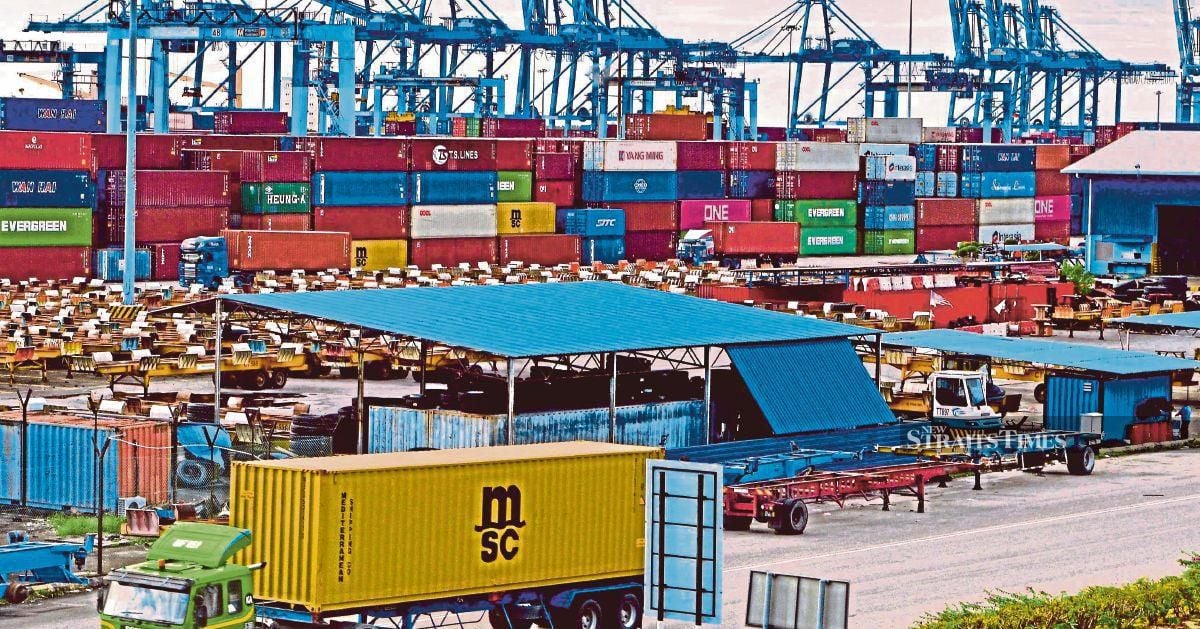
KUALA LUMPUR: Malaysia’s trade performance beat expectations in October, surging 13.6 per cent to RM277.65 billion as trade, exports and imports all hit record levels.
But economists cautioned that export growth could moderate going into 2026.
Investment, Trade and Industry Ministry said exports climbed for the fourth consecutive month, increasing 15.7 per cent to RM148.32 billion, while imports grew 11.2 per cent to RM129.33 billion.
This resulted in a trade surplus of RM18.99 billion in October, the 66th consecutive month of surplus since May 2020.
OCBC senior Asean economist Lavanya Venkateswaran said the latest numbers exceeded expectations, reflecting both resilient E&E demand and strong regional trade flows.
However, Lavanya said the bank expects some moderation in export growth in 2026.
“The continued strength in E&E exports hinges on the global semiconductor upcycle, which is expected to slow into 2026.
“This along with our house view for slower economic growth in key trading partners in 2026 including China, Japan and EU suggest that external demand conditions could also weaken in 2026,” she told Business Times.
On geopolitical risks, Lavanya cautioned that tariff changes, further US-China tensions and sharper-than-expected slowdowns in major economies remain the key threats that could derail Malaysia’s trade momentum.
Despite these risks, she said Malaysia’s long history of consistent surpluses, having maintained a monthly surplus almost continuously since November 1997, underscores its structural competitiveness.
“We see the trade, and in turn current account surplus, sustaining into 2026,” she said.
Bank Muamalat Malaysia Bhd chief economist Dr Mohd Afzanizam Abdul Rashid said the figures indicate that Malaysia is “cruising at a respectable speed,” supported not only by strong exports but also a sharp rise in capital goods imports.
“So I suppose we are in a sweet spot when it comes to gross domestic product growth for 2025 and it seems that the country should be able to end the year with a growth closer to the top forecast range (4.0 per cent to 4.8 per cent),” he said.
Mohd Afzanizam warned that the worst-case scenario would be a sharp fall in US demand.
However, he noted that internal political and judicial pushback in the United States against tariff measures, as well as their inflationary impact on American consumers, may limit the scale or duration of such policies.
Compared to other Asean peers, Mohd Afzanizam believes that Malaysia’s performance remains impressive, particularly in higher-value semiconductor-related activities.
He highlighted that other areas such as agri-food, chemical and some machinery and equipment also need to have more attention as they have been recording trade deficits.
“I am not saying that we should record a trade surplus balance in all products. But the deficit figure might give us a signal that this warrants attention and perhaps more investment needs to be spent in order to improve the scalability and productivity,” he said.
Economist Dr Geoffrey Williams said Malaysia’s trade resilience has surprised on the upside despite tariff volatility.
“This is counter to the conventional view that the tariff issues would be damaging. Actually, overall trade, exports and net trade are stronger,” he said.
Williams emphasised that while global risks remain beyond Malaysia’s control, policy responses at home are critical.
“A continuing focus on diversifying trade, reducing trade barriers and promoting competitiveness is essential,” he said.
William noted that although the trade surplus had narrowed between August 2023 and mid-2025, it is now strengthening again.
Sustaining this trend, he said, will be crucial for trade to meaningfully support growth and reduce reliance on domestic demand.
“Reducing non-tariff barriers under the ART agreement is essential, and implementation will be key under the new trade and investment minister,” he added.
© New Straits Times Press (M) Bhd