
ENERGY security might not be a term that is uppermost in many people’s thoughts.
Malaysia sits on an oil-rich platform, has natural gas, and hydropower is abundant enough that the country can even think about exporting it.
Malaysia is not alone in not thinking about energy security overmuch.
Even if we were to take a poll of what people around the world consider is the most important thing that governments should secure, energy security would not be in the Top 10 list.
Yet in today’s world, energy
security should be among the Top Three.
Without energy, how would governments feed industry, fuel manufacturing and power the agriculture sector? Without energy, how would we power up mobile phones, cook food and drive around town?
For decades, Malaysians have been secure in that we have enough energy for our needs. This may well change in less than a decade.
Reserves can run low, and basins dry up.
For countries like Japan and South Korea, which are fully dependent on imported energy, it is a constant battle to find sources of energy that will not dry up too soon or be disrupted by conflicts.
This is where Canada comes in.
On June 30 , the first shipment of Canada’s liquefied natural gas was made from the British Columbia port of Kitimaat to Japan.
That shipment was seen as a miracle of sorts. LNG Canada is owned by a consortium of companies — Shell Canada with 40 per cent, Petronas with 25 per cent, Mitsubishi Japan and PetroChina with 15 per cent each, and Korean Gas taking up the remaining five per cent.
It was a project that, despite its importance, took nearly 15 years to get off the ground.
There were countless discussions with the indigenous First Nation tribes, the back-and-forth between provincial and federal requirements, and the priority on sustainability and the environment. But the partners’ commitment saw the project through.
LNG Canada has the potential to make Canada — which sits on at least 200 years’ worth of natural gas reserves — one of the major players in LNG exports, surpassing even Malaysia’s fifth-place status.
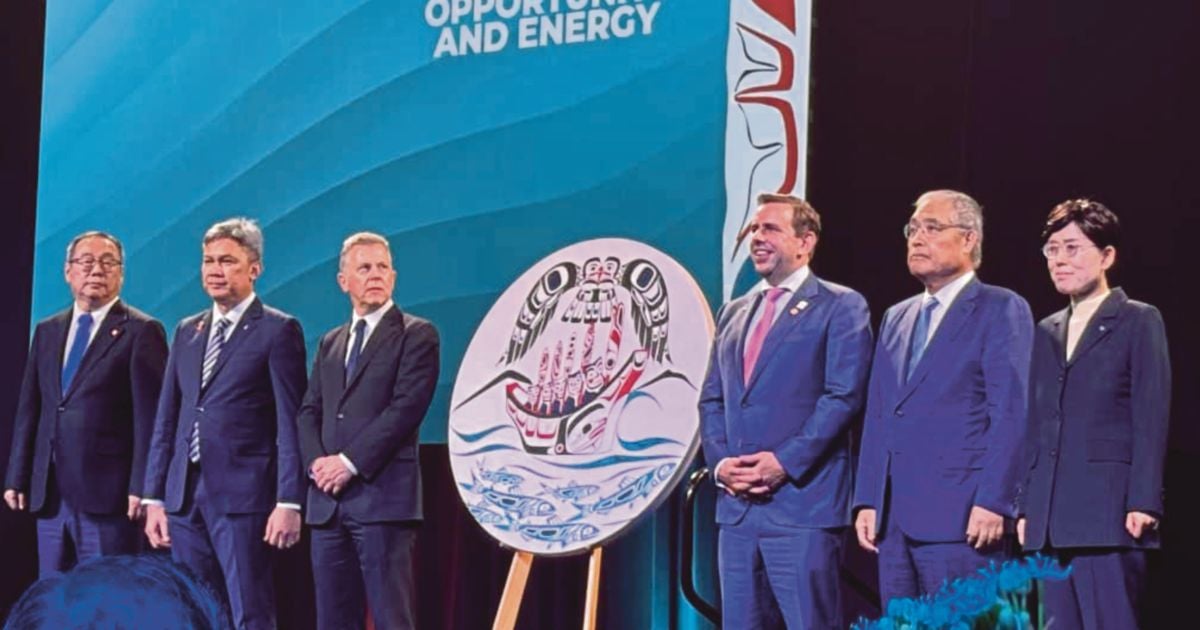
I was privileged to attend the launching ceremony in Vancouver on Sept 26. But more important, perhaps, was the site visit to Kitimaat, which was arranged the very next day.
There we were, representatives of the five stakeholders, transported via a chartered plane to a small airfield.
I sat beside Petronas’ vice-president of LNG Assets, Abang Yusuf Abang Puteh, and together with his team, we occupied the three last rows of the plane.
Though the day started off rainy, by the time we boarded the bus, trundled past the pipes and arrived at the port, the sun had made an appearance.
Words cannot describe the pride I felt, standing at the water’s edge where the flags of the five countries were flapping in the breeze: Canada, China, Japan, Korea… and Malaysia.
The Jalur Gemilang was up there with the “big” guys.
No longer are we just a trading partner to Canada; we are now also one of their major investors, with a significant stake in their ascendance as an energy supplier.
As the clamour for more and more energy gets louder, the job for Petronas to meet the energy needs of Malaysia becomes more challenging.
* The writer is a foreign service officer who has served in bilateral and multilateral posts
© New Straits Times Press (M) Bhd